The Baby Scoop Era: When Adoption Wasn't Always a Choice
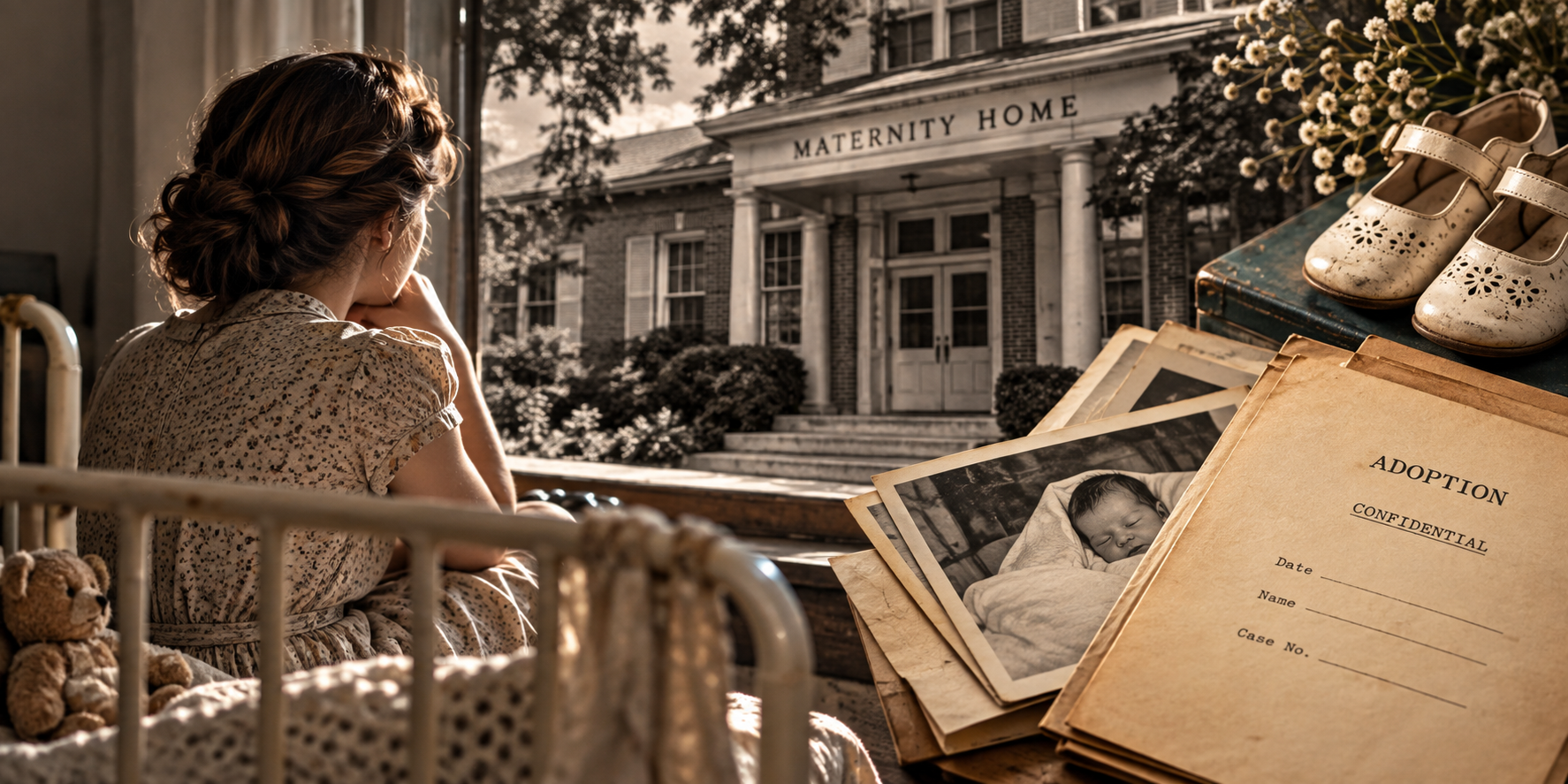
An examination of unmarried motherhood, institutional pressure, adoption practices and the meaning of informed consent in postwar America.
The Question
During the decades following World War II, did unmarried American mothers freely choose adoption, or were some pressured into surrendering children they wanted to raise?
What role did maternity homes, adoption agencies, medical professionals, families and prevailing social attitudes play in those decisions?
And how can we distinguish voluntary adoption from coercion when examining historical adoption records?
Why This Matters
Adoption is frequently discussed from the perspective of providing children with permanent families. However, understanding its history also requires examining the circumstances under which children became available for adoption.
During the mid-20th century, unmarried pregnant women encountered significant social, financial and institutional obstacles to raising their children.
Some chose adoption. Others subsequently reported that they had been pressured, misled or denied meaningful alternatives.
These experiences raise an important question about informed consent: Can a decision be considered freely made when the surrounding circumstances substantially restrict the available choices?
What the Evidence Establishes
What Was the Baby Scoop Era?
The term Baby Scoop Era commonly describes the period between approximately 1945 and 1973, when the United States experienced elevated rates of infant adoption alongside strong social stigma surrounding unmarried motherhood.
The precise beginning and end of the period vary between historical accounts.
Following World War II, marriage and the nuclear family occupied a prominent place in American social expectations.
Pregnancy outside marriage could threaten a young woman's education, employment, housing, family relationships and social standing.
For some women, these circumstances resulted in placement in maternity homes, where they remained during pregnancy and sometimes until shortly after childbirth.
Although these institutions differed in their policies and practices, historical research and firsthand testimony document cases in which women experienced substantial pressure to surrender their children.
1. Maternity Homes: Protection, Isolation or Both?
Maternity homes existed long before the Baby Scoop Era.
Historically, some were established to provide shelter, medical assistance and social support to unmarried pregnant women.
During the postwar decades, however, the relationship between maternity homes and adoption agencies became particularly significant.
Some institutions provided accommodation while facilitating adoption placements. Their stated purpose was often to protect unmarried women from public stigma and provide their children with what institutions considered more socially acceptable family arrangements.
Historical testimony reveals that the experiences of residents varied.
Some women received assistance during difficult circumstances. Others reported isolation, restricted communication, intense pressure to surrender their children and inadequate information about their legal options.
Consequently, the existence of a maternity-home placement does not independently establish either coercion or voluntary relinquishment.
The policies of individual institutions and the experiences of their residents must be examined.
2. Social Expectations and the Meaning of Choice
Unmarried motherhood carried significant social consequences during much of the Baby Scoop Era.
Women could encounter rejection from their families, exclusion from educational opportunities and limited employment prospects.
Marriage was frequently treated as a prerequisite for acceptable parenthood.
These expectations influenced how families, religious organizations, social workers and medical professionals responded to unmarried pregnancy.
Adoption was sometimes presented as the responsible solution, while parenting was portrayed as unrealistic or inappropriate.
For women without independent financial resources, family support or access to alternative housing, these circumstances could substantially limit their choices.
However, it would be historically inaccurate to conclude that every unmarried mother experienced identical pressure or that every adoption during this period was involuntary.
Individual circumstances differed considerably.
3. Institutional Pressure and Coercive Practices
Historical research and survivor testimony document several practices associated with coercive adoption relinquishment.
These included presenting adoption as the only realistic option, withholding information about parenting alternatives, applying sustained emotional pressure and discouraging mothers from maintaining contact with their children.
Some women reported being told that surrendering their children was necessary to provide them with acceptable futures.
Others described experiences in which their wishes were disregarded or their understanding of adoption's permanence was inadequate.
Ann Fessler's oral-history research documents more than 100 women's experiences of relinquishment during this period.
Their testimony provides important evidence of how institutional expectations and family pressures operated.
However, oral histories cannot independently establish the prevalence of particular practices across every adoption agency or maternity home in the United States.
They document individual experiences that researchers can examine alongside contemporary institutional records, professional publications and historical statistics.
4. How Many Children Were Affected?
Establishing the precise number of coerced adoptions during the Baby Scoop Era presents substantial methodological difficulties.
Historical accounts frequently cite approximately 1.5 million relinquishments during the postwar period. Other researchers employ different estimates and date ranges.
These figures must be interpreted carefully.
Total adoption statistics may include stepparent adoptions, relative adoptions, independent placements and agency placements.
Estimates concerning unmarried mothers may use different definitions and populations.
Most importantly, an adoption count cannot establish whether a particular relinquishment was voluntary.
Determining the prevalence of coercion would require reliable information about individual circumstances, institutional practices and the availability of meaningful alternatives.
The historical evidence demonstrates that coercive practices occurred. It does not establish a universally accepted national total of coerced adoptions.
5. Why Did Adoption Practices Change During the 1970s?
The decline in traditional infant relinquishment during the 1970s reflected several overlapping developments.
Changing attitudes toward unmarried motherhood, expanded access to contraception, changes in reproductive law and increasing opportunities for women to pursue education and employment all affected reproductive and parenting decisions.
Social and financial support for unmarried parents also evolved.
These developments changed the circumstances in which some women considered adoption.
However, attributing the decline to any single legal decision or social change would oversimplify a complicated historical transition.
The experiences of unmarried mothers also continued to vary according to race, economic circumstances, geography and access to institutional support.
6. What Happened to the Mothers and Children?
For some families, the consequences of adoption during this period extended across generations.
Former maternity-home residents have described enduring uncertainty about their children's circumstances, difficulty obtaining adoption records and complicated experiences of searching for relatives.
Adopted adults have likewise described challenges associated with restricted access to information about their biological families.
Other individuals have reported different experiences, including positive relationships with their adoptive families and varying perspectives on adoption itself.
These accounts are not mutually exclusive.
An adopted person may value their adoptive family while questioning the circumstances surrounding their adoption.
Similarly, a mother may believe that her child received loving care while maintaining that her own relinquishment was not freely chosen.
Understanding this history requires allowing these experiences to coexist.
Important Context and Limitations
Three distinctions are essential when interpreting the Baby Scoop Era.
First: Legal relinquishment and informed consent are not interchangeable concepts. The circumstances surrounding a decision matter.
Second: Documented coercive practices should not automatically be attributed to every maternity home, adoption agency or adoption completed during the period.
Third: Historical adoption statistics cannot independently establish the number of involuntary relinquishments.
Additionally, much of the widely discussed oral-history research focuses on white American women. Their experiences provide substantial historical evidence but should not be presented as representative of every racial or socioeconomic group.
Examine the Evidence
Primary historical sources
Penelope L. Maza, reproduced by the University of Oregon's Adoption History Project.
This historical statistical report documents changes in American adoption during the Baby Scoop Era. Its national estimates include approximately 72,000 total adoptions in 1951, 175,000 in 1970 and 129,000 in 1975. These totals include multiple adoption categories and should not be interpreted as counts of coerced infant relinquishments.
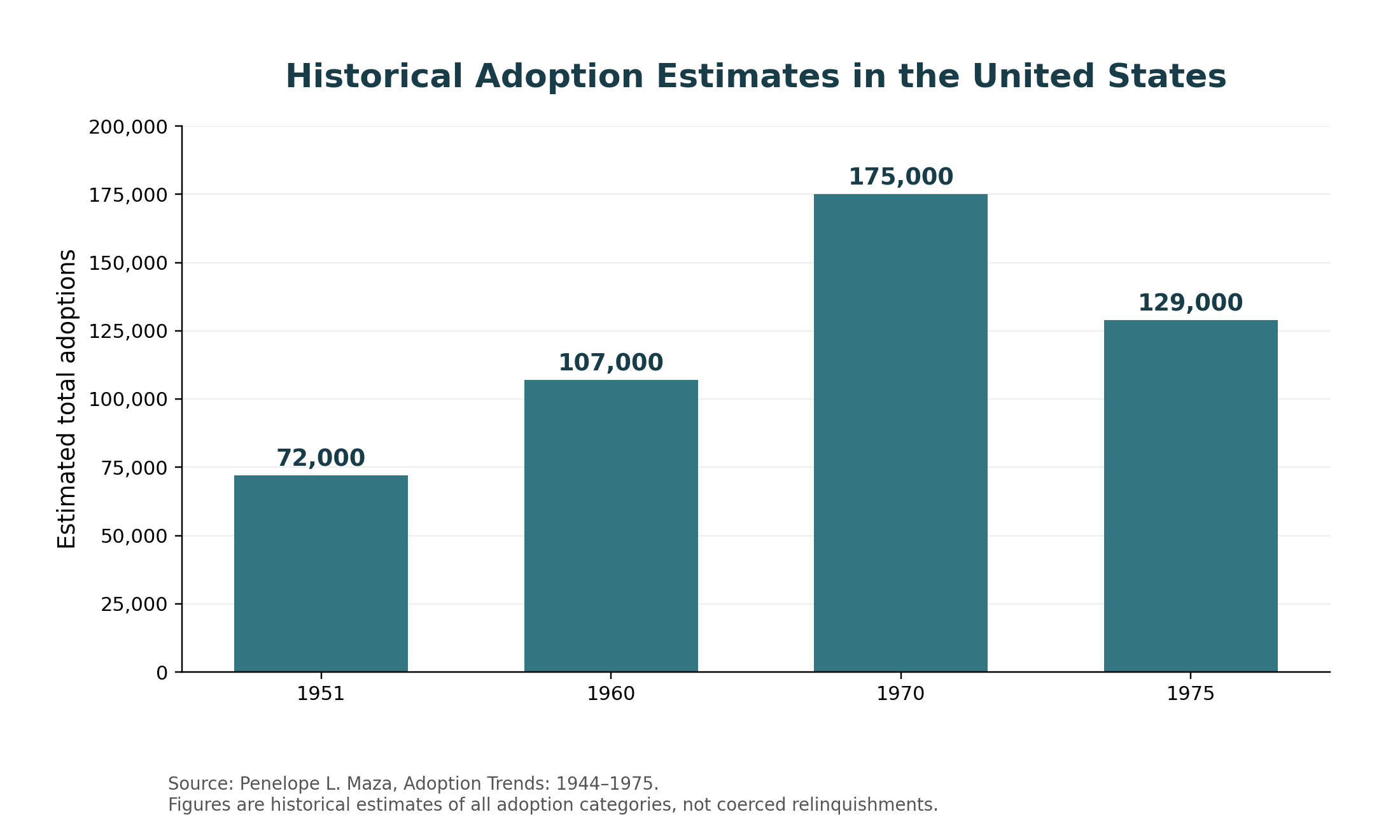
Historical Adoption Estimates
2.Florence Crittenton Home of Norfolk Records
Old Dominion University, Special Collections and University Archives.
An archival collection containing institutional records from the Florence Crittenton Home in Norfolk, Virginia. The collection includes reports, administrative materials and documents relating to unmarried motherhood and child care. Access restrictions apply to certain personal and medical records.
3. Adoption History Project: Historical Document Archives
A collection of historical documents, including professional publications, correspondence, adoption studies and institutional materials from the twentieth century.
Particularly relevant are documents concerning unmarried parents, adoption eligibility, child-placement practices and prevailing professional attitudes.
Secondary historical sources
Ann Fessler, Penguin Press, 2006.
Fessler combines oral histories with historical research to examine the experiences of women who relinquished children during the postwar decades. Her work is especially useful for investigating reported coercion and the social circumstances surrounding relinquishment.
Because participants were interviewed retrospectively, their accounts should be considered alongside contemporary documentation when establishing broader historical patterns.
2. Adoption History: Birth Parents
Ellen Herman, University of Oregon.
An academic historical overview examining changing attitudes toward unmarried parenthood, the development of adoption practices and the relationship between adoption and prevailing social expectations.
It also addresses racial differences in adoption practices, an important limitation in historical accounts that concentrate primarily on white, middle-class women.
3. Maternity Homes and Coerced Adoption
The Washington Post, November 19, 2018.
Historical reporting incorporating interviews with women who lived in maternity homes during the 1950s and 1960s. It provides firsthand accounts of institutional pressure and the circumstances surrounding adoption relinquishment. (This is behind a pay wall)
4. The Cradle: Historical Narrative
The Cradle, institutional historical publication.
An adoption organization's account of its own history, including maternity-home arrangements during the postwar decades.
This provides an institutional perspective that can be compared with independent historical scholarship and firsthand testimony. Because the organization is describing its own activities, the account should not be treated as independent verification of its historical practices.
What Remains Unanswered?
How widespread were coercive practices across individual institutions?
How frequently did mothers receive accurate information about their legal rights and parenting alternatives?
How did adoption experiences differ across racial, economic and geographic communities?
And how should historians evaluate institutional records when they conflict with firsthand accounts?
Further research into contemporary institutional policies, government records and individual experiences may clarify these questions.
Conclusion
The Baby Scoop Era demonstrates why the history of adoption cannot be understood solely through the number of children placed with adoptive families.
The circumstances surrounding relinquishment are equally important.
Historical evidence documents substantial social pressure and instances of institutional coercion. However, the experiences of individual mothers and children varied, and available statistics do not establish a precise national total of involuntary adoptions.
Examining this history provides a foundation for evaluating informed consent, family preservation and the ethical responsibilities of child welfare institutions.
Research status: Documented historical practices; disputed population estimates
Last reviewed: September 26, 2026
Corrections or updates: None at this time.