Who Owns an Adoptee's Birth Story?

Why access to original birth certificates depends on where an adoptee was born and adopted.
The Question
Why can some adult adoptees request their original birth certificates while others must obtain court orders, satisfy additional conditions or remain unable to access them?
An original birth certificate is a historical record of a person's birth. Yet, following adoption, access to that record can become subject to restrictions that vary substantially among states.
This investigation examines how those restrictions developed, the legal arguments used to support them, the reforms that have expanded access and the distinction between obtaining personal records and initiating contact with biological relatives.
Importantly, we'll examine what the historical evidence actually establishes rather than assuming that adoption records have always been sealed for the same reasons.
Why This Matters
For most Americans, obtaining a copy of their original birth certificate is a relatively straightforward administrative process. For many adult adoptees, however, access to that same personal information depends on the laws of the state where their birth was recorded.
Following adoption, an amended birth certificate generally replaces the original certificate as the document available for routine identification purposes. Depending on state law, the original record may become inaccessible without a court order, additional documentation or compliance with other statutory restrictions.
These restrictions raise important questions about identity, privacy and equal access to personal information.
For some adoptees, their original birth certificate represents more than an administrative record. It may contain their original name, the identities of their biological parents or information about their birthplace. Access can be an important part of understanding their personal history, regardless of whether they have any desire to contact their biological relatives.
The issue also extends beyond individual adoptees. It raises broader questions about the legal distinction between protecting someone's private information from public disclosure and restricting that person's access to information about their own birth.
Historical research indicates that these two concepts were not always treated as equivalent. Early adoption confidentiality laws frequently restricted public access without necessarily preventing adult adoptees from obtaining their original birth records.
Understanding how these restrictions developed, what purposes they were intended to serve and how states have subsequently changed their laws is essential to evaluating the arguments surrounding adoption records today.
At the heart of this investigation is a fundamental question: Who should have the authority to control an adult's access to the documented history of their own birth?
What the Evidence Establishes
1. Why Were Adoption Records Sealed?
A frequently repeated explanation is that adoption records were sealed to guarantee birth parents lifelong anonymity.
The historical evidence tells a more complicated story.
Legal scholar Elizabeth J. Samuels examined the development of adoption confidentiality laws and found that many early laws distinguished between protecting records from public inspection and preventing adult adoptees from accessing their own information.
In the late 1940s and early 1950s, most states reportedly sealed adoption court records while continuing to permit adult adoptees to obtain their original birth certificates. Even in 1960, approximately 40% of states retained some form of adult adoptee access.
This distinction is essential to understanding how adoption confidentiality developed.
Confidentiality is not the same as secrecy from the person whose birth was recorded.
Confidentiality: Restricting access to personal information by members of the public.
Sealed records: Restricting access according to statutory rules, potentially including restrictions on the person named in the record.
Lifelong anonymity: Preventing identifying information from being disclosed throughout an individual's lifetime.
The University of Oregon's Adoption History Project identifies Minnesota's 1917 adoption legislation as an important development in establishing confidential adoption records. During the following decades, similar protections spread across the country.
These policies developed during a period when unmarried pregnancy carried considerable social stigma and adoption increasingly came to be presented as the creation of an entirely new family.
Samuels's research identifies several historical considerations behind record-sealing laws, including protecting children from public disclosure of their birth circumstances and protecting adoptive families from possible interference.
Her analysis challenges the assumption that guaranteeing birth parents lifelong anonymity was the original, universal purpose of these laws.
What did birth mothers actually agree to?
This question deserves particular attention.
In a 2013 examination of adoption surrender documents, Samuels investigated claims that birth mothers had been promised lifelong anonymity when they relinquished their children.
Her analysis of the historical documents did not support the broad assertion that birth mothers were routinely offered or guaranteed lifelong anonymity. She also documented the perspectives of birth mothers who subsequently advocated for adult adoptees' access to original birth records.
That finding does not establish that no birth parent ever received an assurance of confidentiality. Individual circumstances, agency practices and legal provisions varied.
It does, however, demonstrate why a universal historical claim about promised anonymity requires evidence rather than repetition.
2. How Unequal Is Access Across the United States?
There is no single federal law granting every adult adoptee in the United States access to their original birth certificate.
Access is principally governed by state law. Eligibility can depend on the state where the original birth record was filed, the adoptee's age, the date of adoption and other statutory conditions.
According to the Adoptee Rights Law Center's July 2026 legal review, 17 states provide qualifying adult adoptees unrestricted access to their original birth certificates. The organization classifies other jurisdictions according to the restrictions imposed on obtaining those records.
These categories require careful interpretation. A state that permits access subject to redaction is legally different from one that requires a court order, even though neither provides unrestricted access.
Similarly, access beginning at age 18 and access beginning at age 24 are not identical policies.
A national comparison must preserve these differences rather than treating every state as simply open or closed.
3. What Happens When States Expand Access?
Virginia provides a recent example of how a state can change its approach.
Effective July 1, 2026, Virginia eliminated the previous court-order requirement for adult adoptees born in the state who seek their original birth certificates.
Under the new law, eligible individuals can submit an application, identification and the required fee to the Virginia Department of Health.
Virginia: Separating access from contact
Virginia's law permits birth parents to submit a contact preference form indicating whether they welcome contact, prefer no contact or would prefer communication through an intermediary.
Importantly, that preference does not prevent the adult adoptee from obtaining the original birth certificate.
This arrangement illustrates a distinction that frequently becomes obscured in discussions about adoption records.
Obtaining a document containing identifying information is not the same action as contacting a person identified in that document.
A birth parent may have preferences concerning future communication regardless of whether an adult adoptee can access their own historical birth record.
Virginia's approach addresses these issues separately.
However, the existence of this law does not establish how frequently reunions occur, whether contact preferences are respected in practice or how affected individuals experience the changes. Those are separate empirical questions.
4. Three States, Three Different Approaches
The following examples illustrate why a nationwide resource must distinguish among state laws rather than describe access as a single national policy.
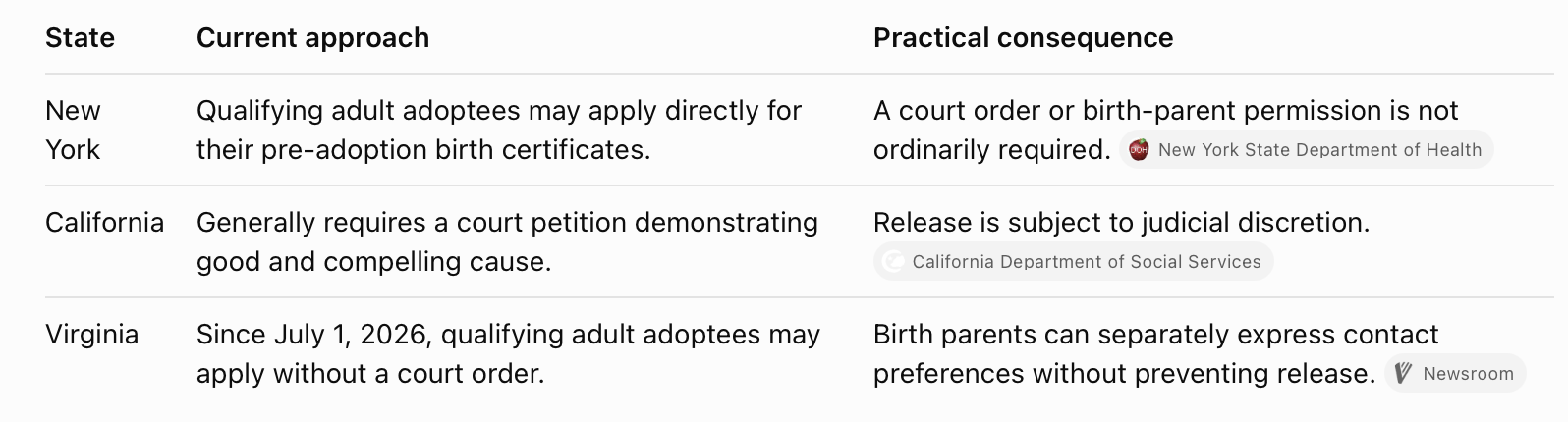
These examples demonstrate that access is a question of legal eligibility, not merely whether a record still exists.
They also illustrate why an adoptee should consult the vital records authority responsible for the original birth record rather than assume that the law in their current state of residence controls access.
5. What Evidence Exists About Reopening Records?
Oregon provides an unusually useful historical example because its health authority publishes administrative data from the period following the implementation of its access law.
Oregon's first year of expanded access : 5,832 Orders for original birth records with 5,565 Certificates issued.
Among the birth parents who submitted forms during this period, more selected direct contact than no contact.
However, this finding has an important limitation: only people who submitted forms are represented. Their preferences cannot be generalized to every birth parent affected by the law.
Likewise, the number of certificates issued demonstrates substantial use of the access procedure. It does not independently measure family reunification, psychological outcomes, unwanted contact or satisfaction with the legislation.
Oregon's records provide useful administrative evidence, but they should not be presented as a comprehensive assessment of every consequence of expanded access.
6. What About Privacy?
Privacy is central to this discussion, but several distinct interests are frequently grouped together.
They include an adult adoptee's interest in obtaining personal historical information, a birth parent's interest in controlling personal contact, and the privacy of adoption court proceedings and other individuals named in confidential records.
These interests do not necessarily require identical legal solutions.
Oregon and Virginia demonstrate that states can provide access to original birth certificates while maintaining separate procedures for expressing contact preferences.
Advocates of unrestricted access argue that adult adoptees should be able to obtain records of their own births without requiring another person's permission.
Those who support restrictions raise concerns about privacy, historical expectations of confidentiality and the possibility of unwanted contact.
Historical research complicates the assertion that all birth parents were promised lifelong anonymity. Nevertheless, that finding alone does not resolve every contemporary privacy concern.
The legal question is how states balance these interests. The empirical question is what consequences follow from the different approaches.
They should be investigated separately.
7. Why Does Access Matter Beyond Family Reunification?
Original birth certificates may provide information about a person's birth name, birthplace and the identities recorded for their birth parents.
However, an original certificate is not necessarily complete or accurate. Oregon's health authority expressly cautions that some original records contain missing or incomplete parental information.
Access to a birth certificate is also different from access to a complete adoption file or updated family medical history.
A certificate may identify a parent without supplying information about hereditary medical conditions. Conversely, an adoptee may receive nonidentifying medical information without obtaining the names recorded on their original birth certificate.
These distinctions matter because different information needs may require different records.
For some adult adoptees, obtaining an original birth certificate is principally about documenting their personal history. For others, it may be part of a broader search for family connections or information relevant to their health.
The existence of these different motivations does not establish that every adoptee wants contact with biological relatives.
Important Context and Limitations
This investigation establishes that original birth certificate access varies significantly among states and that the historical development of sealed records was more complicated than a universal promise of lifelong anonymity.
It does not establish that every birth parent shares the same privacy preferences, that every adoptee wishes to pursue reunification or that expanded access produces identical outcomes in every jurisdiction.
The Adoptee Rights Law Center's nationwide figures reflect its published legal classifications as of July 2026. They should not be mistaken for an independently completed statutory audit by InventingNormal.
Additionally, the federal Child Welfare Information Gateway's frequently cited nationwide statutory compilation is current through December 2019. It remains useful for understanding legal frameworks but should not be used alone to describe state laws in September 2026.
Examine the Evidence
"The Idea of Adoption: An Inquiry into the History of Adult Adoptee Acc" by Elizabeth Samuels
Elizabeth J. Samuels, Rutgers Law Review, 2001. An extensive legal history examining the development of sealed birth records.
"Surrender and Subordination: Birth Mothers and Adoption Law Reform" by Elizabeth J. Samuels
Elizabeth J. Samuels, Michigan Journal of Gender & Law, 2013. Examines historical surrender documents and competing claims about birth-parent anonymity.
Adoption History: Confidentiality and Sealed Records
University of Oregon Adoption History Project. Historical background on confidentiality and sealed records.
STATE STATUTES
Virginia Removes Court‑Order Requirement for Adoptees Seeking Original Birth Records - Newsroom
What Remains Unanswered?
Several questions deserve further investigation:
How do adult adoptees describe the effects of gaining access to their original birth certificates?
What do representative studies reveal about birth parents' privacy and contact preferences?
How often do courts grant petitions in states that require judicial approval?
What measurable outcomes have followed recent legislative reforms?
How do original birth certificate restrictions affect adoptees who were born in one state but adopted in another?
Conclusion
Access to an original birth certificate is not governed by a uniform national standard in the United States.
Historical research demonstrates that early adoption confidentiality laws did not universally prevent adult adoptees from accessing their birth records. Restrictions developed over time, influenced by changing legal practices and social attitudes.
Today, states continue to take different approaches. Some provide direct access, others impose conditions, and others generally require judicial authorization.
Recent reforms in Virginia, together with Oregon's longer-established system, demonstrate that states can distinguish access to historical records from preferences concerning personal contact.
The evidence also establishes important limits. Obtaining an original birth certificate does not guarantee complete information, access to an entire adoption file or a relationship with biological relatives.
Ultimately, the central legal question is not whether every adoptee wishes to search for their biological family.
It is what information an adult should be entitled to obtain about their own birth, and what restrictions a state can place on that access.
Research status: Ongoing
Last reviewed: September 26, 2026
Corrections or updates: None at this time.
Geographic scope: United States
Research focus: Original birth certificates, sealed adoption records, privacy and adult adoptees' access rights