Does Permanency Require Adoption?
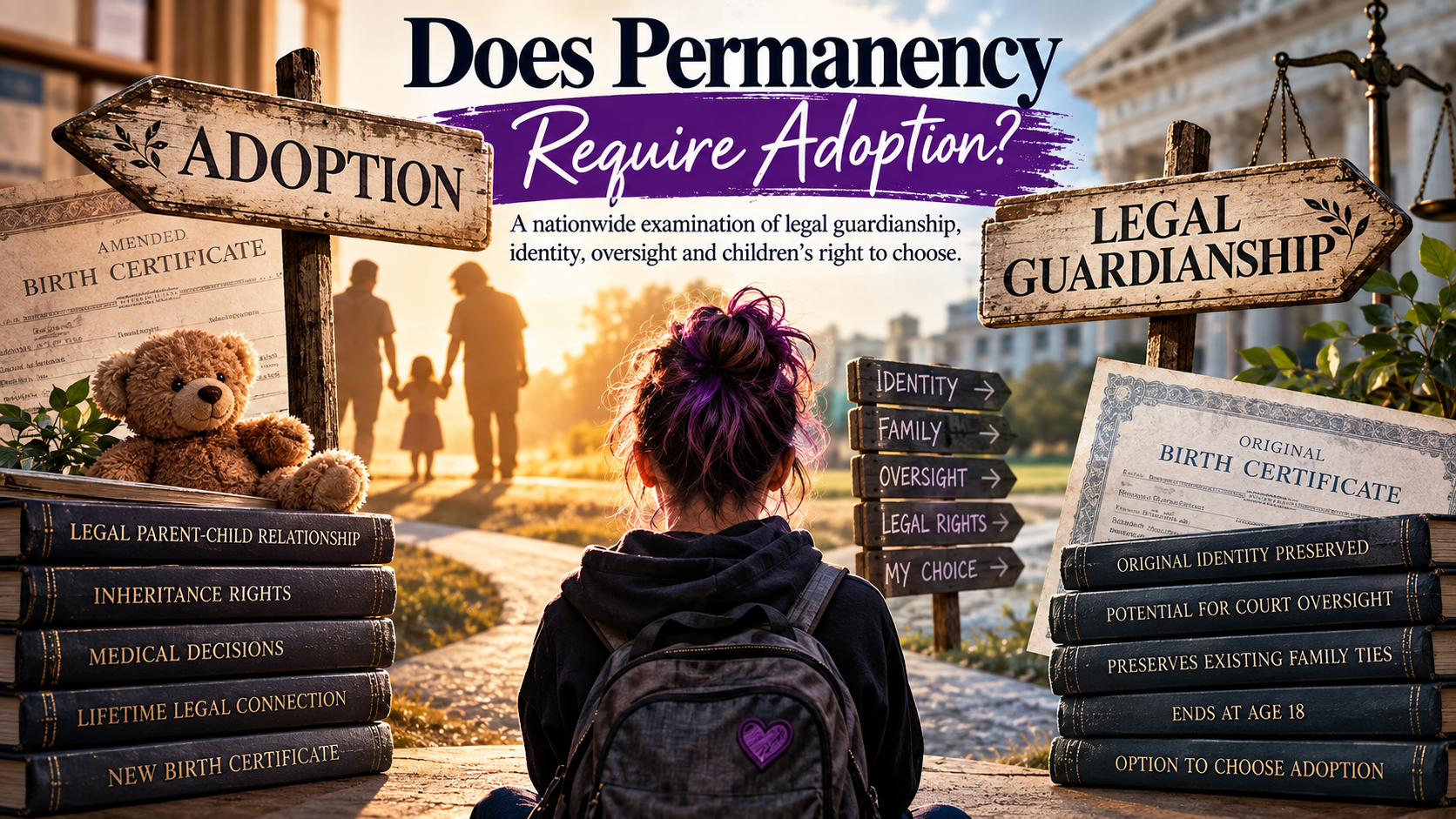
Examining legal guardianship, adoption, identity, oversight and the right to choose in the United States
The Question
Must a child be legally adopted to experience permanency, or can permanent legal guardianship provide lasting family stability while preserving additional rights and choices?
Some adult adoptee advocates argue that legal guardianship offers important alternatives to adoption. Three recurring arguments concern ongoing oversight, preservation of original birth certificates and allowing individuals to decide whether they wish to be adopted after reaching adulthood.
These arguments raise a broader question: What does permanency actually require, and whose legal rights are protected by the arrangements designed to provide it?
Why This Matters
Adoption and legal guardianship are both recognized arrangements through which children can receive long-term care. However, they establish different legal relationships and can have different consequences for identity, parental rights, financial support and decision-making.
Under federal child welfare law, legal guardianship is expressly defined as a judicially created relationship intended to be permanent and self-sustaining. It transfers important caregiving and decision-making responsibilities to the guardian without necessarily creating a new legal parent-child relationship.
This distinction challenges a common assumption: that providing a child with a permanent family arrangement necessarily requires adoption.
It also establishes an important limitation. Federal recognition of guardianship does not mean every form of guardianship is available in every state or that all guardianships provide identical protections.
What the Evidence Establishes
1. What Is the Difference Between Adoption and Legal Guardianship?
Adoption generally creates a permanent legal parent-child relationship. Adoptive parents assume the legal status of parents, with the associated rights and responsibilities.
Legal guardianship gives another adult legally recognized authority to care for a child and make specified decisions on the child's behalf. The scope of that authority, the circumstances under which it can be modified and the extent to which existing parental rights continue depend on applicable law.
Federal law recognizes kinship guardianship as a potential permanency arrangement for eligible children leaving foster care. Its assistance program requires, among other conditions, that reunification and adoption have been determined inappropriate for the particular child.
That eligibility requirement matters. The federal Kinship Guardianship Assistance Program is not a general guardianship program available to every family, nor does it establish that guardianship must be considered preferable to adoption.
2. Does Legal Guardianship Provide More Oversight?
Claim: Requires qualification
This is one of the most important claims to investigate, because the existence of judicial oversight is different from a requirement for routine home visits.
Adoption placements may be subject to investigation, supervision and court review before finalization. Following finalization, adoptive families generally are not subject to continuing routine court supervision simply because the family was formed through adoption.
Guardianship, meanwhile, remains a court-created legal arrangement. Depending on state law and the type of guardianship, courts may retain authority to require reports, review the arrangement or consider petitions seeking changes.
However, there is no universal federal requirement that every permanent guardian receive an annual home visit or welfare check.
Federal law establishes eligibility and assistance requirements for qualifying kinship guardianships. It does not establish a nationwide annual home-inspection requirement for all permanent guardians.
Three forms of oversight must therefore be distinguished:
Judicial oversight: A court retains legal authority over a guardianship and may review it under applicable law.
Administrative reporting: A guardian may be required to submit periodic reports or documentation.
Direct welfare monitoring: A professional actually meets with or visits the child to assess their circumstances.
A state may require one without requiring all three.
This distinction also raises a question about effectiveness. A mandatory annual report does not necessarily establish that a child has been interviewed privately or that an independent professional has evaluated the home.
Research finding: Guardianship can preserve opportunities for judicial oversight that generally do not continue after adoption finalization. However, a nationwide claim that permanent guardianship guarantees annual welfare checks is unsupported.
3. Does Guardianship Preserve a Child's Original Birth Certificate?
Claim: Generally supported
Adoption and guardianship have substantially different implications for a child's legal identity documents.
Following adoption, states customarily issue an amended birth certificate identifying the adoptive parents. The original certificate is generally retained separately, and access is governed by state law.
The federal Child Welfare Information Gateway documents significant differences among states regarding an adopted person's ability to obtain their original birth certificate. Some permit qualifying adult adoptees to request it directly, while others impose additional conditions or require judicial authorization.
Guardianship ordinarily does not trigger the creation of an amended birth certificate replacing the child's original parental information.
This difference is central to the argument advanced by advocates who believe that a caregiving arrangement should not require changes to a person's original identity documents.
However, several distinctions deserve attention.
Preserving an original birth certificate does not automatically guarantee unrestricted access to every related record. Likewise, guardianship does not necessarily preserve every existing legal relationship with a child's biological relatives, particularly when parental rights have already been terminated.
The precise legal consequences depend on the child's circumstances and applicable state law.
Research finding: Guardianship ordinarily preserves the child's original birth certificate without the amendment process associated with adoption. This is a meaningful, identifiable legal distinction.
4. Does Guardianship Allow Individuals to Choose Adoption as Adults?
Minor guardianships ordinarily end when the individual reaches adulthood. This creates an opportunity for a person raised by guardians to consider adult adoption without having had that legal relationship established during childhood.
Adult adoption is legally available in the United States, but its requirements vary considerably.
For example, Ohio permits adult adoption only under specified circumstances, including certain preexisting caregiving relationships. It is not an unrestricted option available to every adult in every situation.
This is important because the argument for delaying adoption until adulthood is sometimes expressed as though every person will have the same legal options upon turning 18.
They will not.
There is also an important distinction between a child's ability to consent to adoption and an adult's ability to make an independent decision.
Some states already require the consent of older children before adoption. Kansas, for example, generally requires consent from a child older than 14 who meets the statute's specified capacity requirement. The argument then becomes, can a child give informed consent?
Consent during childhood and independently choosing adoption as an adult are not identical forms of decision-making.
A child's consent occurs within a process involving other adults and legal authorities. Adult adoption generally allows the person being adopted to participate as an adult, although other statutory requirements may apply.
Research finding: Guardianship can preserve the opportunity to decide about adoption in adulthood. However, that opportunity is subject to state adult-adoption laws, and guardianship itself does not guarantee continuing financial or legal support after the individual reaches adulthood.
5. What Legal Protections Might Differ?
A comparison would be incomplete without examining the protections that adoption can establish and the protections that guardianship may preserve.
The following table summarizes general legal distinctions. It is not a substitute for examining the applicable state statutes.
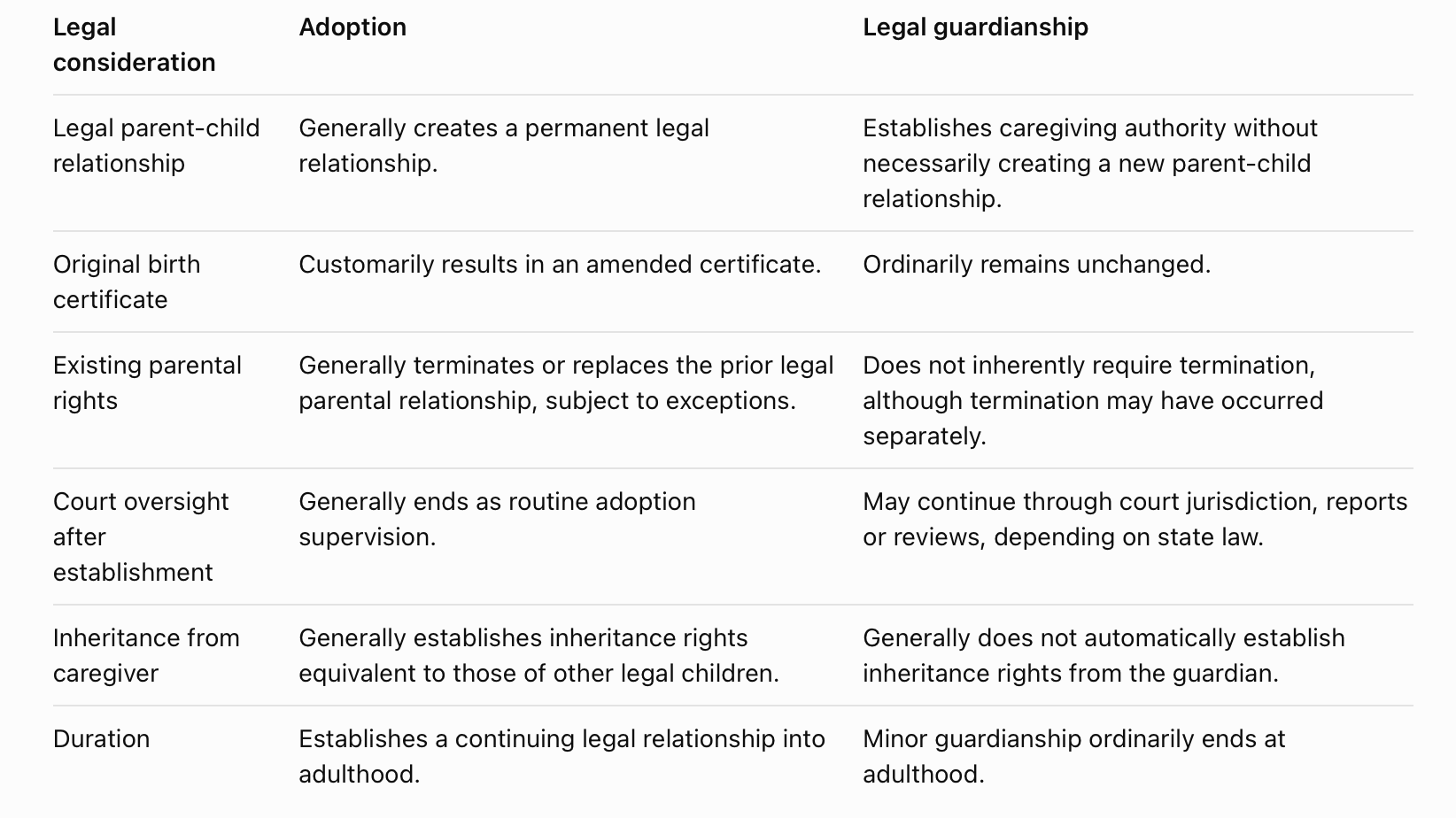
The birth-certificate distinctions are documented by the federal Child Welfare Information Gateway. Federal law separately recognizes the caregiving authority associated with guardianship. Inheritance consequences depend on state law and the precise family relationship.
5. Inheritance and financial security
Inheritance deserves particular attention because it illustrates why neither arrangement can be evaluated solely by its name.
Adoption generally establishes automatic inheritance rights from adoptive parents when they die without a will.
Guardianship ordinarily does not establish the same automatic inheritance relationship between guardian and child. Guardians may therefore need additional estate-planning arrangements to provide comparable protection.
At the same time, guardianship may preserve inheritance rights involving the child's original family that could otherwise change following adoption.
A Social Security Administration legal opinion concerning New York, for example, concluded that the transfer of guardianship in the circumstances examined did not extinguish the child's inheritance rights from a biological parent. This is an illustration of state-specific law, not a universal rule.
Federal financial assistance also complicates the comparison.
Under Title IV-E, qualifying children may receive adoption assistance or kinship guardianship assistance. Both programs have eligibility requirements, and payments can sometimes continue beyond age 18 under specified circumstances.
The federal kinship guardianship provisions also address successor guardians when a guardian dies or becomes incapacitated, provided the applicable statutory and agreement requirements are satisfied.
Consequently, it would be inaccurate to suggest that guardianship always ends all support at 18 or that adoption always guarantees superior financial protection.
6. Does Legal Permanency Guarantee Relational Permanency?
Federal law describes legal guardianship as an arrangement intended to be permanent and self-sustaining. That definition concerns legal authority and caregiving responsibility.
Neither adoption nor guardianship can independently guarantee that a child will experience lasting emotional security, healthy family relationships or continuing support throughout adulthood.
This distinction matters when evaluating the argument that adoption is necessary to provide permanency.
Legal permanency describes an established legal arrangement. Relational permanency concerns the continuity of meaningful relationships and dependable personal connections.
A legal relationship may continue even when personal relationships become strained. Conversely, a relationship formed through guardianship may remain meaningful long after the legal guardianship ends.
These are different dimensions of permanency and should not be treated as interchangeable.
Important Context and Limitations
What this research does not establish
That every permanent guardianship receives annual judicial review or independent welfare visits.
That guardianship always preserves contact with biological relatives.
That every individual can pursue adult adoption without restrictions upon turning 18.
That all guardianships provide identical inheritance, financial or legal protections.
That either legal arrangement guarantees lifelong family stability.
It is also important to distinguish ordinary minor guardianship from guardianship established through the child welfare system.
Federal kinship guardianship assistance is a particular program with specific eligibility conditions. Its requirements should not be applied indiscriminately to private guardianships or other state guardianship arrangements.
Similarly, adoption law encompasses several different circumstances, including stepparent, relative, private domestic and foster-care adoptions.
The legal consequences of these arrangements can differ.
Examine the Evidence
1. 42 U.S.C. § 673: Adoption and Guardianship Assistance Program
Federal eligibility, assistance agreements and successor guardianship provisions.
2. 42 U.S.C. § 675: Definitions
Federal definition of legal guardianship and provisions concerning extended eligibility.
3. Child Welfare Information Gateway: Access to Adoption Records
State-law differences concerning original birth certificates and access to adoption records.
4. Social Security Administration: New York Legal Opinion
A state-specific example examining guardianship and inheritance rights.
Illustrative state statutes
5. Kansas Statutes § 59-2129: Adoption Consent
Illustrates statutory requirements concerning consent by older children.
6. Ohio Revised Code § 3107.02
Illustrates restrictions and eligibility conditions governing adult adoption.
What Remains Unanswered?
Three questions warrant additional research.
First, how many states require ongoing judicial reviews, annual reports or independent welfare visits following the establishment of permanent guardianship? A complete answer requires reviewing individual state statutes and distinguishing the different types of guardianship.
Second, what evidence exists regarding the effectiveness of post-permanency oversight? The presence of a reporting requirement does not establish that children receive meaningful opportunities to raise concerns.
Third, how do individuals who experienced guardianship describe its effects on identity, family relationships and their ability to make decisions about adoption? Legal analysis can identify available rights, but it cannot substitute for the experiences of the people affected.
These questions would make valuable subjects for subsequent research.
Conclusion
Adoption is not the only legally recognized arrangement through which children can receive permanent care in the United States. Federal law expressly recognizes legal guardianship as a permanency arrangement and provides financial assistance for certain eligible kinship guardianships.
The arguments raised by adult adoptee advocates identify several documented legal distinctions.
Guardianship ordinarily preserves original birth certificates, does not inherently establish a replacement legal parent-child relationship and can preserve the opportunity to consider adoption in adulthood.
It may also provide continuing avenues for judicial oversight, although annual reviews and welfare visits are not universally required.
Adoption establishes a continuing legal parent-child relationship and generally provides associated inheritance and other legal protections. Guardianship can provide caregiving stability while preserving different aspects of a child's existing legal identity and family relationships.
The central distinction is therefore not simply whether an arrangement is permanent.
It is which legal relationships are established, which existing rights are preserved, what safeguards remain available and how the individual participates in decisions affecting their identity and family.
Those questions cannot be answered uniformly across the United States. They require attention to the applicable laws and the circumstances of each child.
Research status: Federal framework verified; state-specific provisions vary
Last reviewed: September 26, 2026
Graphic scope: United States
Editorial note: This is a national legal overview, not a completed 50-state statutory audit. The annual-oversight question remains open pending that more extensive review.