Is There Really a Shortage of Babies Available for Adoption?
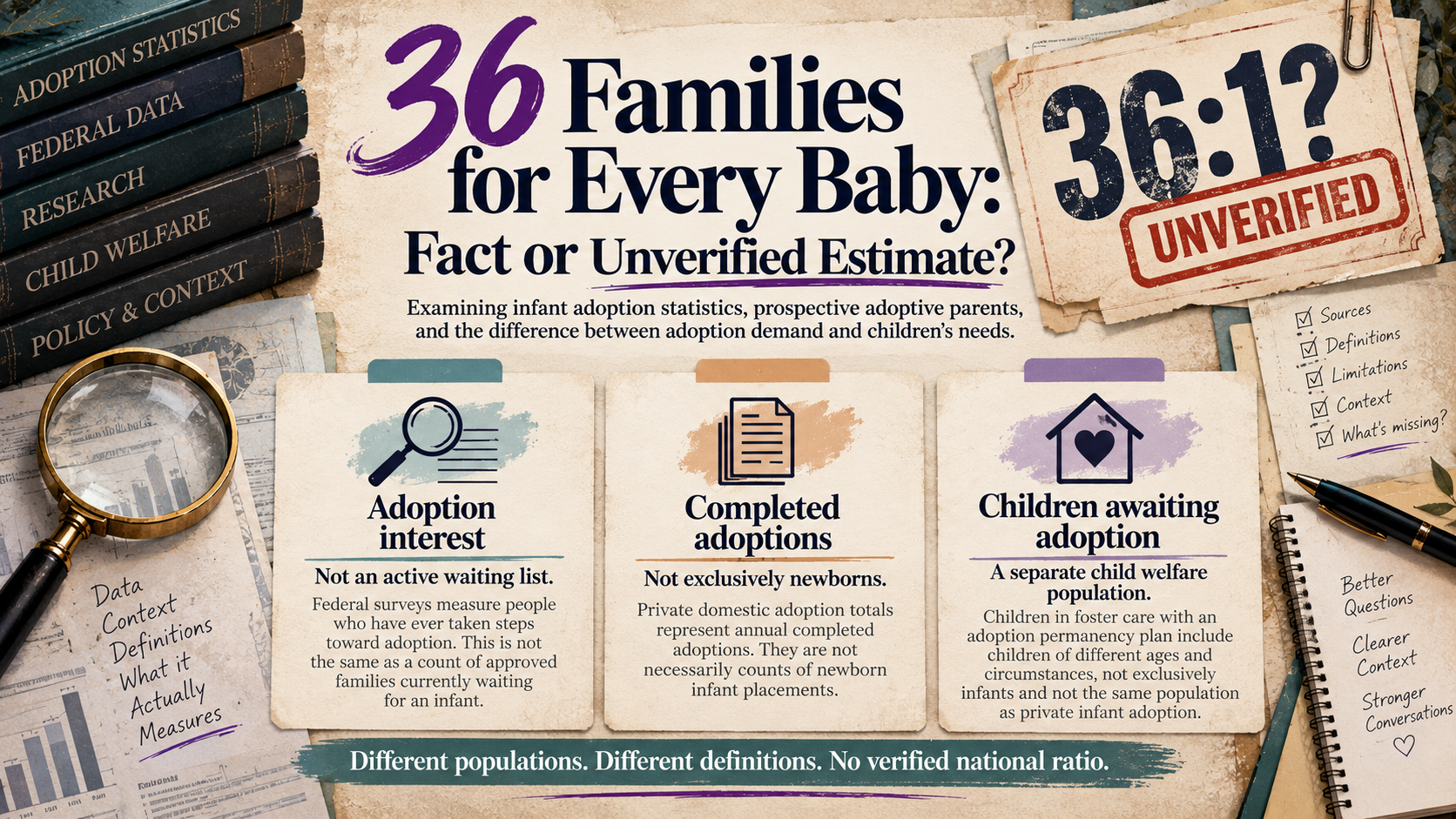
Investigating the claim that 36 families are waiting for every available infant, what national statistics actually measure, and the distinction between adoption demand and children's needs. The fact that these children are being described in a supply and demand for profit industry is particularly disturbing, and should be heavily questioned.
The Question
Are there really 36 prospective adoptive families waiting for every infant available for adoption in the United States?
How many infants are placed through private domestic adoption each year? How many families are actively waiting? And does demand for infant adoption establish that there is a shortage of children who need permanent families?
Answering these questions requires distinguishing between adoption interest, active adoption applications, completed infant placements and children awaiting adoption through the public child welfare system.
Why This Matters
Adoption statistics frequently appear in conversations about family formation, reproductive decisions and child welfare.
One widely repeated claim suggests that approximately 36 families are waiting for every infant placed for adoption.
However, this statistic is often presented without explaining how prospective adoptive families were counted, which children were included or when the estimate was calculated.
These omissions matter.
An individual who has considered adoption is not necessarily an approved prospective adoptive parent.
Similarly, the number of infants placed through private adoption does not establish the number of children who need permanent families.
Understanding the distinction is essential to interpreting adoption statistics accurately.
What the Evidence Establishes
1. Where Did the 36-Families Claim Originate?
The claim that 36 families are waiting for every infant placed for adoption appears in numerous adoption-agency publications and advocacy materials.
Some versions of the claim rely on an estimate of approximately two million couples seeking adoption.
However, tracing the claim to a reliable national count of approved families actively waiting to adopt infants presents substantial difficulties.
A 2023 academic legal article examining adoption and reproductive decision-making specifically notes the absence of reliable figures quantifying the number of couples waiting to adopt.
The article documents earlier publications repeating the 36-to-one estimate, including material published in 2012.
Although these references establish that the claim has circulated for many years, they do not independently verify its underlying population estimate.
The earliest original calculation and its methodology remain unconfirmed.
2. What Do Federal Surveys Actually Measure?
The Centers for Disease Control and Prevention conducts the National Survey of Family Growth.
Historical survey results provide information about Americans' adoption experiences and whether respondents have taken steps toward adopting a child.
For example, data collected during 2011–2015 estimated that approximately two million American women aged 18–44 had taken steps toward adoption at some point.
However, the survey measured lifetime experience within a particular population.
It did not establish that two million couples were simultaneously approved and actively waiting to adopt infants.
It also did not establish that every respondent remained interested in adoption or intended to adopt an infant.
Consequently, the survey estimate cannot be substituted for a national waiting-family count.
3. How Many Private Domestic Adoptions Occur?
The National Council For Adoption published updated national adoption research in March 2025.
Its research estimated that 25,503 private domestic, non-stepparent adoptions occurred in 2022, compared with 24,720 in 2019.
These estimates provide valuable information about completed private domestic adoptions.
However, the category should not automatically be treated as a count consisting exclusively of newborn infants.
Additionally, completed adoptions represent an annual flow of placements.
The number of families waiting at a particular moment represents a population measured at a specific point in time.
Dividing an uncertain waiting-family estimate by annual completed adoptions would not establish a reliable ratio without consistent definitions and verified data.
4. Does Demand Establish a Shortage?
The word shortage requires a clear definition.
A private adoption agency may have more approved prospective adoptive families than available infant placements.
That circumstance can create extended waiting periods for participating families.
However, it does not independently establish a shortage of children who need permanent families.
The two statements describe different questions.
One concerns the number of prospective parents seeking a particular type of adoption.
The other concerns the needs of children who cannot safely remain with their existing families.
A child welfare analysis must distinguish between those populations.
5. What About Children Awaiting Adoption in Foster Care?
The federal Adoption and Foster Care Analysis and Reporting System collects information about children involved in public foster care.
Its fiscal year 2024 reporting identified approximately 70,418 children in foster care with an adoption permanency plan.
Approximately 3% were younger than one year old.
However, a child having an adoption permanency plan does not necessarily mean that the child is legally available for immediate adoption.
Some children have existing relationships with relatives or foster caregivers who may become their permanent families.
Others may be part of sibling groups or have individual circumstances requiring specialized permanency planning.
Additionally, the federal foster-care adoption population is distinct from the population involved in private domestic infant adoption.
Combining these categories without accounting for their differences produces misleading conclusions.
6. Why Might Prospective Adoptive Families Experience Long Waiting Periods?
Waiting periods can be influenced by several factors.
These include the number of available placements through a particular agency, geographic considerations, the prospective family's eligibility and the circumstances in which expectant parents consider adoption.
Prospective adoptive families may also have preferences concerning a child's age, health circumstances, openness arrangements or other characteristics.
The existence of a large number of prospective adoptive families does not establish that every family is available for every possible placement.
Furthermore, prospective adoptive parents may register with multiple organizations, creating the possibility of duplicate counting if agency waiting lists are combined.
Reliable national estimates would need to address these issues.
7. What Does Adoption Demand Tell Us About Family Preservation?
Adoption demand measures the interests of prospective adoptive parents.
It does not independently establish whether an expectant parent wants to relinquish their child, whether a child requires an alternative permanent family or whether appropriate support could enable safe family preservation.
These are separate questions.
An expectant parent's circumstances may involve financial difficulties, housing instability, family relationships or other challenges.
The existence of prospective adoptive families does not determine whether adoption is the appropriate outcome in an individual situation.
Similarly, recognizing the importance of family preservation does not establish that every child can safely remain with their biological parents.
Child welfare decisions require consideration of individual circumstances rather than assumptions derived from adoption-demand statistics.
8. What Would a Reliable National Estimate Require?
To calculate the number of prospective adoptive families waiting for infants, researchers would need consistent information from participating adoption agencies and independent adoption professionals.
The data would need to distinguish between initial inquiries, submitted applications, completed home studies, approved families and families actively seeking placement.
Researchers would also need a method for identifying families registered with multiple organizations.
A credible waiting-family ratio would require a clearly defined reporting period and a comparable measure of infant placements.
Without these elements, the frequently repeated 36-to-one estimate cannot be independently confirmed.
Important Context and Limitations
Four distinctions are essential.
First: Taking steps toward adoption at some point is not equivalent to being approved and actively waiting.
Second: Private domestic adoption totals are not necessarily counts of newborn infant placements.
Third: Children with adoption permanency plans in foster care are not necessarily legally available for immediate adoption.
Fourth: Demand for infant adoption does not independently establish how many children need alternative permanent families.
These distinctions do not mean that prospective adoptive families never experience long waiting periods.
They mean that waiting periods and national population estimates are different measurements.
Examine the Evidence
1. NSFG - Listing A - Key Statistics from the National Survey of Family Growth
Centers for Disease Control and Prevention, National Center for Health Statistics.
Historical National Survey of Family Growth results documenting Americans' experiences with adoption, including women who reported having taken steps toward adoption. This is our primary source for evaluating the frequently cited estimate of millions of prospective adoptive parents.
2. New Report Shows Dramatic Decline in Pandemic Adoptions
National Council For Adoption, March 17, 2025.
Presents findings from the organization's national adoption research, including estimated private domestic adoption totals for 2019 and 2022.
NCFA is an adoption advocacy organization, so its methodology and definitions should be considered alongside its reported findings.
3. Federal Adoption and Foster Care Reporting, FY 2024
U.S. Department of Health and Human Services, Children's Bureau.
Official federal foster-care reporting, including information about children with adoption permanency plans and children whose parental rights have been terminated.
4. Children in foster care waiting for adoption by age group | KIDS COUNT Data Center
Annie E. Casey Foundation, KIDS COUNT Data Center.
Provides age-specific data on children awaiting adoption through foster care, allowing readers to examine how the population differs across age groups.
Additional research and historical references
5. Academic Analysis of Adoption Demand and Reproductive Decision-Making
University of California, Davis Law Review, Volume 57, 2023.
Examines adoption-related claims in discussions about reproductive decisions. Particularly relevant is its discussion of the absence of reliable national waiting-family figures and its references tracing the 36-to-one claim through earlier publications.
6. American Adoptions - How Many Couples are Waiting to Adopt a Baby?
Google Search
7. Products - Data Briefs - Number 12 - January 2009
Centers for Disease Control and Prevention, January 2009.
Examines historical adoption experiences and changing relinquishment patterns. Useful background for understanding why historical adoption statistics cannot automatically describe contemporary adoption practices.
What Remains Unanswered?
How many approved prospective adoptive families are currently waiting for private domestic infant placements?
How many are registered with multiple agencies?
What proportion of completed private domestic adoptions involve newborn infants?
How do waiting periods vary according to agency practices, geographic location and prospective family characteristics?
And how might more comprehensive reporting improve public understanding of adoption demand?
These questions require additional research and more consistent national data collection.
Conclusion
The claim that 36 families are waiting for every infant placed for adoption is widely repeated, but its underlying national waiting-family estimate remains unverified.
Existing federal surveys and adoption research provide important information about adoption interest and completed placements. However, they do not establish a reliable contemporary ratio of approved families to available infants.
The evidence supports distinguishing demand for infant adoption from the needs of children who require permanent families.
Understanding that difference is essential to interpreting adoption statistics responsibly.
The fact that these children are being described in a supply and demand for profit industry is particularly disturbing, and should be heavily questioned.
Research status: Partially established; national waiting-family estimates remain unverified
Last reviewed: September 26, 2026
Corrections or updates: None at this time.