Are Children More Likely to Experience Abuse in Foster or Adoptive Homes?
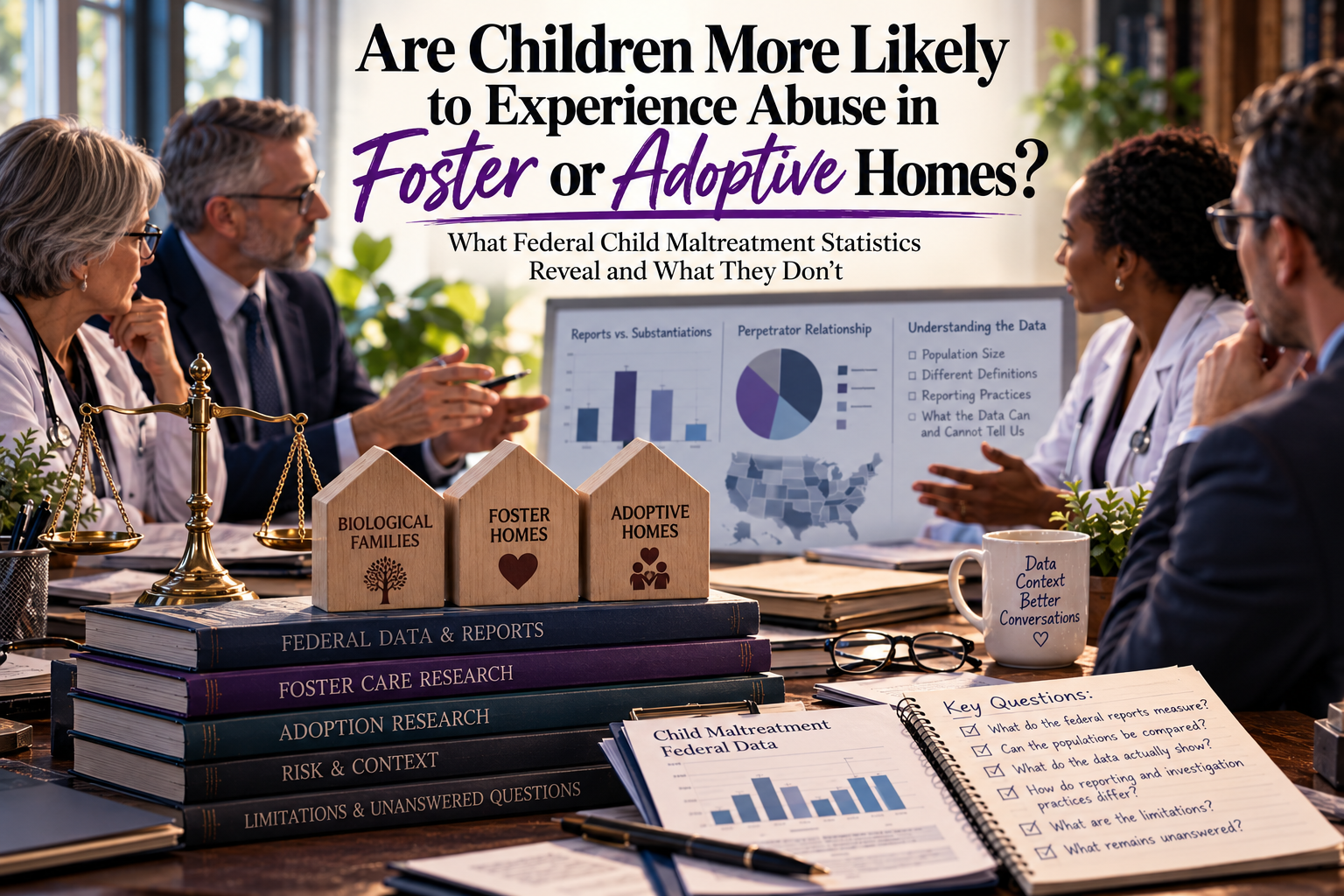
What federal child maltreatment statistics reveal, what they leave unanswered, and why the relationship between a child and their caregiver matters when interpreting abuse statistics.
The Question
Are children more likely to experience abuse in biological, foster or adoptive families?
Can federal child maltreatment statistics reliably establish which caregiving environments have higher rates of abuse?
And does the legal relationship between a child and their caregiver influence how maltreatment is reported, investigated or understood?
These questions require examining what existing research measures, how child welfare agencies classify caregivers and whether the available data permit meaningful comparisons.
Why This Matters
Child maltreatment statistics frequently appear in discussions about adoption, foster care and family preservation.
However, statistics identifying the relationships between perpetrators and children are often interpreted as though they establish the comparative safety of different family structures.
They do not necessarily provide that information.
For example, knowing how many substantiated maltreatment cases involved biological parents does not establish the proportion of children living with biological parents who experience maltreatment.
Similarly, knowing how many cases involved foster parents does not independently establish the risk experienced by children living in foster homes.
A meaningful comparison requires consistent definitions, reliable population data and comparable reporting methods.
Without those elements, seemingly straightforward statistics can produce misleading conclusions.
What the Evidence Establishes
1. What Do Federal Child Maltreatment Reports Measure?
The United States Children's Bureau publishes annual Child Maltreatment reports using information submitted by state child protective services agencies.
These reports include information about maltreatment referrals, investigations, victim determinations, maltreatment types and perpetrator relationships.
The underlying National Child Abuse and Neglect Data System, or NCANDS, provides important information about cases that come to the attention of participating child welfare agencies.
However, the system does not capture every instance of child maltreatment.
Some incidents are never reported. Others are reported but cannot be substantiated using the applicable investigative standards.
State reporting practices, definitions and investigative procedures can also differ.
Consequently, federal statistics describe documented child welfare activity rather than providing a complete census of every instance of abuse or neglect.
2. What Do the Most Recent Federal Statistics Show?
The federal Child Maltreatment 2024 report includes information about victims and their relationships to identified perpetrators.
Among participating states, parents accounted for approximately 89.1% of reported perpetrator relationships associated with identified victims.
Foster parents accounted for approximately 0.4%.
These figures require substantial qualification.
The percentages describe reported relationships associated with identified maltreatment victims. They do not describe the proportion of children in each family structure who experience abuse.
Additionally, children can have multiple identified perpetrators, meaning relationship percentages can total more than 100%.
The parent category does not provide a straightforward national comparison separating every biological and adoptive parent.
These statistics therefore cannot establish whether children face greater maltreatment risks in biological, foster or adoptive families.
3. What Does Research Establish About Maltreatment in Foster Care?
A study by Amy Dworsky, Svetlana Shpiegel and Julie S. McCrae, first published online in July 2025, examined maltreatment among children in out-of-home care.
The researchers analyzed information from NCANDS and the Adoption and Foster Care Analysis and Reporting System.
They found that 6.5% of children in out-of-home care during a reporting year were the subject of a maltreatment report.
Approximately 0.9% were identified as substantiated maltreatment victims.
The researchers also found differences in maltreatment types and substantiation patterns.
Children with disabilities were more likely to experience documented maltreatment in out-of-home care than children without disabilities.
Importantly, the study's population included children in out-of-home care rather than exclusively children living with foster parents.
Its findings should not be presented as a national estimate of abuse committed specifically by foster parents.
4. Why Are Direct Comparisons Difficult?
Several methodological problems complicate comparisons between biological, foster and adoptive families.
First, these populations differ in size.
Far more children live with their biological parents than with foster parents. Raw case counts cannot account for that difference.
Second, children entering foster care frequently have previous experiences of maltreatment or other adversity.
Research must distinguish maltreatment occurring before foster care from maltreatment occurring during placement.
Third, reporting environments differ.
Children in foster care may have contact with caseworkers, courts and other professionals who are required to report suspected maltreatment.
However, additional oversight does not necessarily mean that every instance of maltreatment will be reported or substantiated.
Fourth, federal data do not provide a consistently comparable national measure of maltreatment occurring specifically within adoptive families.
Together, these limitations prevent a straightforward national ranking of family structures using existing administrative statistics.
5. What Do We Know About Maltreatment in Adoptive Families?
Historical federal research has examined perpetrator relationships, including adoptive parents.
For example, a federal analysis of data from eighteen states investigated characteristics of male perpetrators and differences associated with their relationships to children.
However, the research examined identified perpetrators rather than calculating the population-wide risk experienced by all children living with different types of parents.
Its findings therefore cannot establish the comparative likelihood of abuse in adoptive families.
Additionally, studies involving children adopted after experiences of maltreatment must distinguish those earlier experiences from maltreatment occurring after adoption.
A child's adoption status alone does not establish when maltreatment occurred or who was responsible.
6. Does Substantiation Establish Whether Abuse Occurred?
Substantiation is an administrative determination made through a child protective services investigation.
It is not identical to a criminal conviction, and investigative standards differ across jurisdictions.
A substantiated case indicates that the responsible agency determined the applicable evidentiary threshold had been met.
An unsubstantiated case does not necessarily establish that maltreatment did not occur.
The distinction matters when comparing populations whose reports may be investigated under different circumstances.
The 2025 out-of-home care study found that reports involving children in out-of-home care were less likely to be substantiated than reports involving other children, even after examining several relevant characteristics.
That finding identifies a difference in administrative outcomes.
It does not, by itself, establish why that difference occurred.
7. Does Society Respond Differently Depending on Who the Parents Are?
Public discussions sometimes suggest that people respond differently to abuse allegations depending on whether the accused caregiver is a biological, foster or adoptive parent.
This is a legitimate research question, but it requires evidence specifically examining public attitudes, professional decision-making or investigative outcomes.
Federal maltreatment statistics alone cannot establish how the public responds to different types of parents.
Similarly, differences in substantiation rates do not independently demonstrate that investigators favor or disfavor a particular family structure.
Such conclusions would require research accounting for case characteristics, available evidence, reporting practices and other relevant factors.
Regardless of family structure, the experiences and safety of children deserve serious consideration.
A child's relationship to an accused caregiver should not determine whether their disclosure is treated with empathy or whether concerns about their safety receive appropriate attention.
8. What Would a Reliable Comparison Require?
A meaningful national comparison would require several types of information.
Researchers would need accurate estimates of the number of children living in each family structure and the length of time those children spent in each environment.
They would also need consistent definitions of maltreatment and reliable information establishing when maltreatment occurred.
Reporting and substantiation practices would need to be examined to identify potential differences between populations.
Finally, researchers would need to account for relevant differences in children's circumstances without treating previous experiences of maltreatment as evidence of abuse by subsequent caregivers.
Without these safeguards, comparisons risk attributing differences to family structure when other explanations may be involved.
Important Context and Limitations
Three distinctions are particularly important.
First: The percentage of identified perpetrators belonging to a particular caregiver category is not the same as the maltreatment rate among children living with that category of caregiver.
Second: A report of suspected maltreatment, a substantiated administrative finding and a criminal conviction are different measurements.
Third: Maltreatment experienced before foster care or adoption must be distinguished from maltreatment occurring afterward.
These limitations do not establish that abuse is absent from any particular caregiving environment.
They establish that the available statistics cannot support every comparison frequently made using them.
Examine the Evidence
U.S. Department of Health and Human Services, Children's Bureau, 2024 reporting year.
The primary source for national child maltreatment statistics. Table 3–9 documents victims' relationships to identified perpetrators, including parents, foster parents, relatives and other caregivers.
The table includes information from 47 states. Because some victims have multiple identified perpetrators, the relationship percentages exceed 100% when combined.
Administration for Children and Families
2. Dataset Details: National Child Abuse and Neglect Data System (NCANDS) Child File, FFY 2023
National Data Archive on Child Abuse and Neglect.
The underlying federal child maltreatment dataset provides information about investigations, dispositions, maltreatment types and perpetrator characteristics.
This resource links to the fiscal year 2023 dataset and its documentation, allowing researchers to examine how administrative information is collected and classified.
3. Male Perpetrators of Child Maltreatment: Findings from NCANDS | ASPE
U.S. Department of Health and Human Services, Office of the Assistant Secretary for Planning and Evaluation.
A historical federal investigation of male perpetrators using data from eighteen states. It examines biological fathers, adoptive fathers, stepfathers and other caregiver relationships.
Its limited population and historical reporting period make it unsuitable for calculating current national comparative risks.
Peer-reviewed research
Amy Dworsky, Svetlana Shpiegel and Julie S. McCrae. First published online July 4, 2025.
This study combines federal administrative data to examine maltreatment involving children in out-of-home care. It provides our principal research findings concerning maltreatment reports, substantiation and differences associated with children's characteristics.
Nina Biehal, Child Abuse Review, 2014.
A critical review of research from the United States, United Kingdom and Australia examining maltreatment in foster care.
The review discusses differences in definitions, reporting thresholds and investigative practices, illustrating why published estimates require careful interpretation.
Wiley Online Library
Peer-reviewed population research examining confirmed child maltreatment and foster care placement in the United States between 2011 and 2016.
Particularly useful for understanding the difference between annual maltreatment rates and estimates of how many children experience maltreatment at some point during childhood.
What Remains Unanswered?
What are the comparable national maltreatment rates among children living with biological, foster and adoptive parents?
How do differences in reporting and investigation affect observed rates?
What explains differences in substantiation outcomes involving children in out-of-home care?
How frequently does maltreatment occur after adoption, as distinct from adversity experienced before adoption?
And does the legal relationship between a child and their caregiver influence public responses to abuse disclosures?
Answering these questions requires research designed specifically to investigate them.
Conclusion
Existing federal data document child maltreatment involving different types of caregivers.
Recent research also provides important information about maltreatment experienced by children in out-of-home care.
However, these findings do not establish a reliable national comparison of abuse risks across biological, foster and adoptive families.
Understanding child safety requires examining the experiences of children, the circumstances surrounding maltreatment and the limitations of the available evidence.
A child's safety and experiences deserve attention regardless of the legal relationship they have with their caregivers.
Research status: Partially established; important comparative data limitations
Last reviewed: September 26, 2026
Corrections or updates: None at this time.