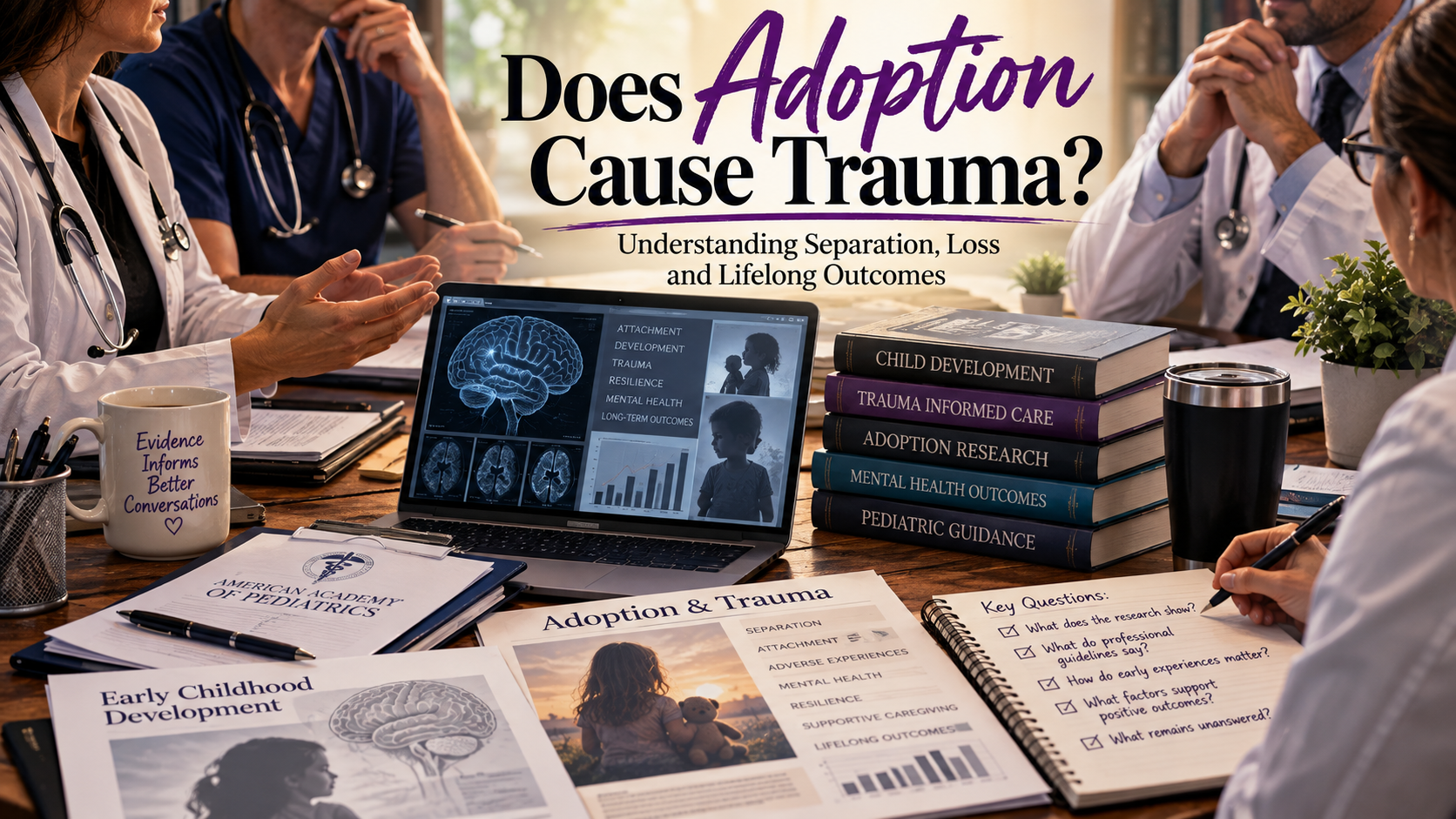
Does Adoption Cause Trauma? Understanding Separation, Loss and Lifelong Outcomes
The Question
Should adoption be recognized as a traumatic event?
Does the separation of a child from their biological parents necessarily cause psychological trauma? And if adoption-related loss is recognized as trauma, does that mean adopted people will experience lifelong psychological harm?
These questions are frequently treated as though they have the same answer.
They do not.
Understanding adoption-related trauma requires distinguishing between potentially traumatic experiences, individual responses to those experiences and long-term psychological outcomes.
Click the link below to view the article in full
Why This Matters
Discussions about adoption-related trauma frequently become polarized.
One perspective emphasizes that adoption can involve significant loss, including separation from biological parents, family relationships, cultural connections and personal history.
Another emphasizes that adoption can provide safety, stability, supportive relationships and opportunities for healthy development.
These observations are not inherently contradictory.
An adopted person can experience meaningful loss while also developing strong relationships with their adoptive family.
Likewise, an adoption can provide a stable home without automatically resolving earlier traumatic experiences.
Understanding these distinctions is essential to discussing adoption without dismissing either the evidence or the experiences of adopted people.
What the Evidence Establishes
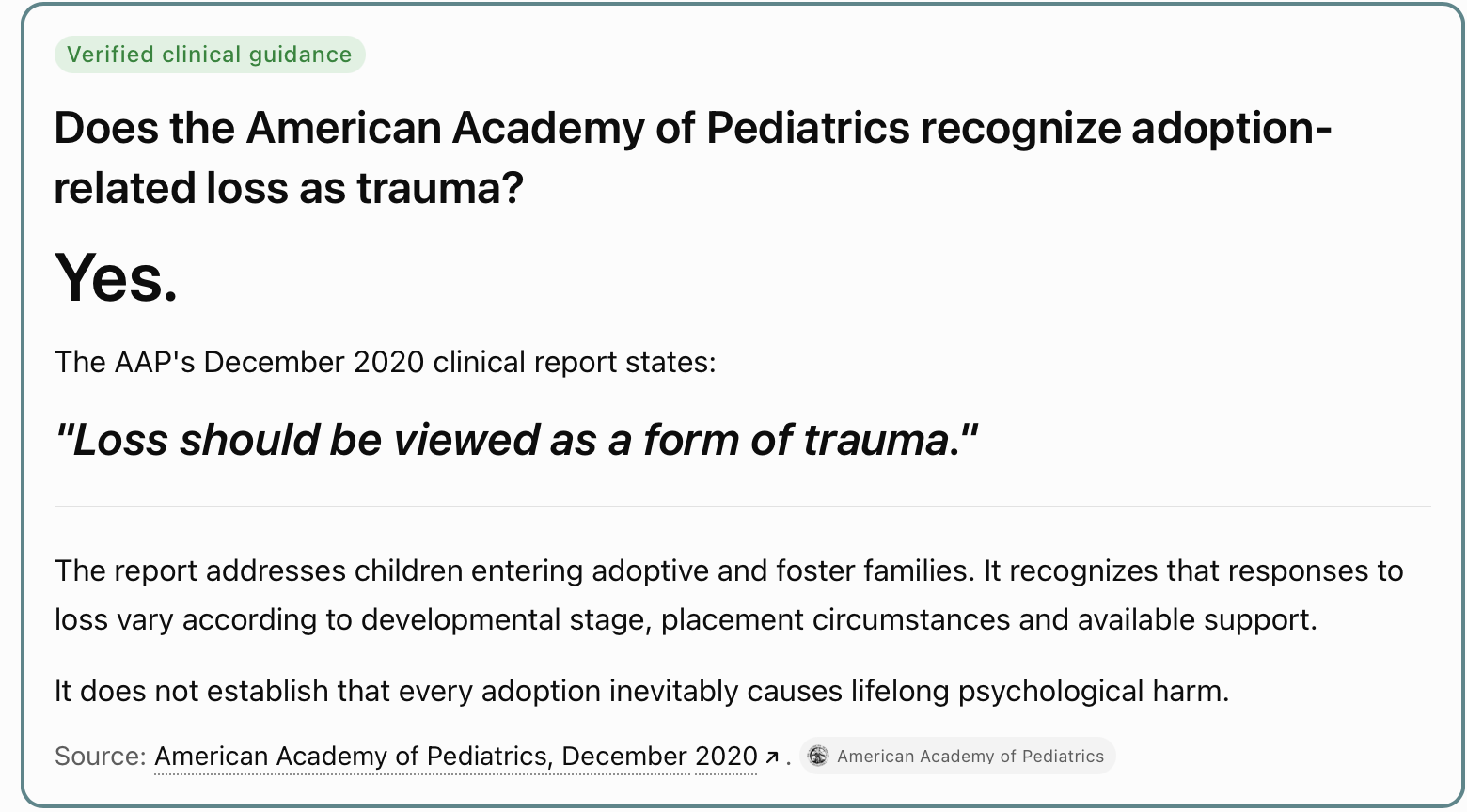
1. Does the American Academy of Pediatrics Recognize Adoption-Related Loss as Trauma?
Yes.
In December 2020, the American Academy of Pediatrics published clinical guidance addressing the developmental, medical and psychological needs of children in adoptive, foster and kinship families.
The report explicitly recommends that loss associated with entering adoptive or foster families be recognized as a form of trauma.
It explains that children entering these families may experience multiple forms of loss and that their responses can differ according to developmental stage, placement circumstances, familiar surroundings and available support.
This is an important professional acknowledgment.
However, the report does not establish that every adoption, regardless of its circumstances, is inherently traumatic or that every adopted person will experience lifelong psychological difficulties.
Its guidance recognizes adoption-related loss while emphasizing individualized assessment and supportive caregiving.
Source: American Academy of Pediatrics, Pediatrician Guidance in Supporting Families of Children Who Are Adopted, Fostered, or in Kinship Care, December 2020.
2. A Traumatic Event Is Not the Same as Lifelong Trauma
Three concepts must be distinguished.
A potentially traumatic event is an experience that may overwhelm an individual's capacity to cope or threaten their sense of safety and security.
Traumatic stress refers to the emotional, behavioral or physiological responses that may follow such an experience.
Long-term trauma-related difficulties are persistent consequences that some individuals experience. They are not an inevitable outcome of every potentially traumatic event.
For example, separation from an established primary caregiver may constitute a traumatic experience.
However, recognizing the separation as potentially traumatic does not establish that the individual will develop a trauma-related disorder or experience lifelong psychological impairment.
Individual responses depend on numerous factors, including the circumstances of separation, developmental stage, previous experiences, subsequent relationships and access to appropriate support.
A traumatic experience is part of someone's history. It is not a predetermined psychological future.
3. Can Infants Experience Separation-Related Stress Without Remembering It?
Yes, although the circumstances matter.
Infants develop emotional and physiological responses to their environments before acquiring the ability to describe experiences verbally or form the kinds of autobiographical memories available later in childhood.
Early relationships and responsive caregiving play important roles in emotional regulation and development.
Disruption of an established caregiving relationship can therefore affect an infant even when that child will not later possess conscious memories of the experience.
However, researchers must distinguish between separation from an established caregiver and the legal process of adoption.
The developmental significance of a separation depends partly on the child's existing relationships, previous experiences and subsequent care.
The absence of conscious memory does not prove that an early experience was inconsequential.
Equally, the possibility of early stress does not establish that every infant adoption produces identical psychological effects.
4. Is Adoption Itself the Traumatic Event?
This question requires distinguishing between adoption as a legal process and the experiences surrounding it.
Adoption legally establishes a parent-child relationship.
However, an adoption may involve several separate experiences, including relinquishment, separation from established caregivers, changes in family relationships, changes in cultural environment and the development of a new family identity.
For some children, separation or previous adversity may be the primary source of traumatic stress.
For others, adoption-related experiences involving identity, belonging, discrimination or restricted access to family information may become significant later in life.
These experiences can occur at different developmental stages and may affect individuals differently.
Consequently, describing adoption as potentially involving trauma is more precise than assuming the legal act of adoption produces the same psychological outcome for every adopted person.
Importantly, this distinction should not be used to dismiss adoptees who identify adoption itself as traumatic in their own lives.
Their experiences remain relevant evidence about the diversity of adoption outcomes.
5. What Does Research Establish About Long-Term Psychological Outcomes?
Adoption research identifies associations between developmental outcomes and experiences occurring both before and after adoption.
A systematic review published in May 2026 examined 40 studies investigating factors associated with anxiety, depression and related internalizing difficulties among adopted children and adolescents.
The researchers identified several pre-adoption factors associated with increased difficulties, including older age at adoption, maltreatment and institutional care.
They also identified post-adoption family characteristics associated with outcomes.
Parental warmth, family cohesion and open communication were associated with fewer internalizing symptoms.
Parenting stress and parental depression were associated with greater difficulties.
These findings demonstrate that adoption outcomes cannot be adequately explained by adoption status alone.
Experiences before adoption and relationships after adoption both matter.
However, associations do not automatically establish causation, and the review's findings should not be interpreted as predictions about individual adopted people.
6. Can Adoption Provide Stability Without Erasing Earlier Trauma?
Yes.
A stable, responsive caregiving environment can support healthy development and help children recover from adversity.
However, providing stability does not automatically eliminate the effects of earlier experiences.
Children may continue processing loss, separation or previous adversity as their understanding of family relationships develops.
The American Academy of Pediatrics recommends honest, developmentally appropriate conversations about adoption and family history rather than withholding information until a child reaches a particular age.
It also emphasizes the importance of recognizing children's emotional experiences and providing appropriate professional support when necessary.
These recommendations recognize that healthy development and unresolved questions about adoption can coexist.
7. What About the Primal Wound?
The concept of the primal wound is widely discussed within adoption communities.
Popularized by Nancy Verrier's book The Primal Wound, the concept proposes that separation from a biological mother produces a fundamental psychological injury.
For some adopted people, this framework provides language for experiences of loss and separation that they previously struggled to describe.
However, the concept should be distinguished from an established clinical diagnosis or a universally demonstrated scientific mechanism.
Developmental research supports the importance of early caregiving relationships and recognizes that separation can produce significant stress.
It does not establish that every separation at birth produces an identical psychological injury or inevitably results in lifelong difficulties.
The personal significance of the primal wound framework and its status as a scientific explanation are separate questions.
8. Why Adult Adoptee Experiences Matter
Research examining childhood outcomes cannot fully describe the experiences of adopted people throughout adulthood.
Questions involving identity, biological family relationships, cultural belonging and access to personal history may develop or change over time.
Adult adoptees may describe experiences that were not apparent during childhood or captured by studies focused on childhood adjustment.
Some identify enduring adoption-related difficulties.
Others describe different experiences, including positive family relationships and psychological well-being.
These accounts should not be forced into a single narrative.
Additionally, positive relationships with adoptive parents do not necessarily invalidate experiences of loss or distress.
A person can value their family relationships while questioning the circumstances surrounding their adoption.
Understanding adoption therefore requires both empirical research and careful attention to the experiences of adopted people themselves.
Important Context and Limitations
Four distinctions are essential when interpreting this research.
First: The American Academy of Pediatrics recognizes adoption-related loss as a form of trauma. This does not establish that every adoption causes lifelong psychological harm.
Second: Separation from an established caregiver and adoption as a legal process are distinct experiences.
Third: Research involving children adopted after maltreatment, institutional care or multiple placements cannot automatically be generalized to every adopted person.
Fourth: The absence of persistent psychological symptoms does not establish that an individual experienced no loss or that their adoption-related experiences were insignificant.
Research findings should also be interpreted with attention to the populations studied, methods used and outcomes measured.
Examine the Evidence
American Academy of Pediatrics, December 2020.
Our central source for the distinction between adoption-related loss and inevitable lifelong harm. The report recommends recognizing loss experienced by children entering adoptive and foster families as trauma while considering individual developmental circumstances and available support.
Children and Youth Services Review, May 2026.
A systematic review of 40 studies examining pre-adoption and post-adoption factors associated with anxiety, depression and related difficulties among adopted children and adolescents.
Particularly useful for explaining why developmental outcomes cannot be attributed to adoption status alone.
American Academy of Pediatrics, October 2012.
An earlier clinical report addressing the pediatrician's role in supporting adoptive families. Its discussion of adoption-related loss provides useful historical context for the AAP's subsequent guidance.
Additional clinical and educational resources
4. Traumatic Separation in Children and Adolescents | The National Child Traumatic Stress Network
National Child Traumatic Stress Network, 2017.
A professional educational resource examining traumatic separation, disrupted attachment and the experiences of children and families involved in out-of-home care.
It includes perspectives from clinicians, people formerly in foster care, and biological and foster parents.
5. Supporting Children Who Have Experienced Trauma
American Academy of Pediatrics.
Clinical resources designed to help pediatricians recognize childhood trauma, support adoptive and foster families, and respond to children's individual developmental and emotional needs.
6. Essential Elements | The National Child Traumatic Stress Network
National Child Traumatic Stress Network.
Describes the essential elements of trauma-informed child welfare, including psychological safety, resilience, family well-being and collaboration with young people and families.
What Remains Unanswered?
How do different circumstances surrounding separation influence long-term outcomes?
What differences exist between adoption at birth and adoption following established caregiving relationships?
How do open adoption, cultural continuity and access to biological family information influence psychological well-being?
What additional research is needed to understand adult adoptees' experiences across the lifespan?
And how can researchers distinguish the effects of adoption-related separation from the effects of adversity experienced before adoption?
These questions warrant continued investigation.
Conclusion
Recognizing adoption-related loss as trauma and claiming that adoption inevitably causes lifelong psychological harm are fundamentally different propositions.
The American Academy of Pediatrics recognizes the significance of adoption-related loss, while developmental research demonstrates that psychological outcomes are influenced by multiple experiences and relationships.
The available evidence supports recognizing potential trauma, responding to individual needs and avoiding universal predictions.
Adoption-related loss deserves acknowledgment.
Individual experiences deserve respect.
And scientific claims deserve careful examination.
Research status: Evidence-supported, with important limitations
Last reviewed: September 26, 2026
Corrections or updates: None at this time.