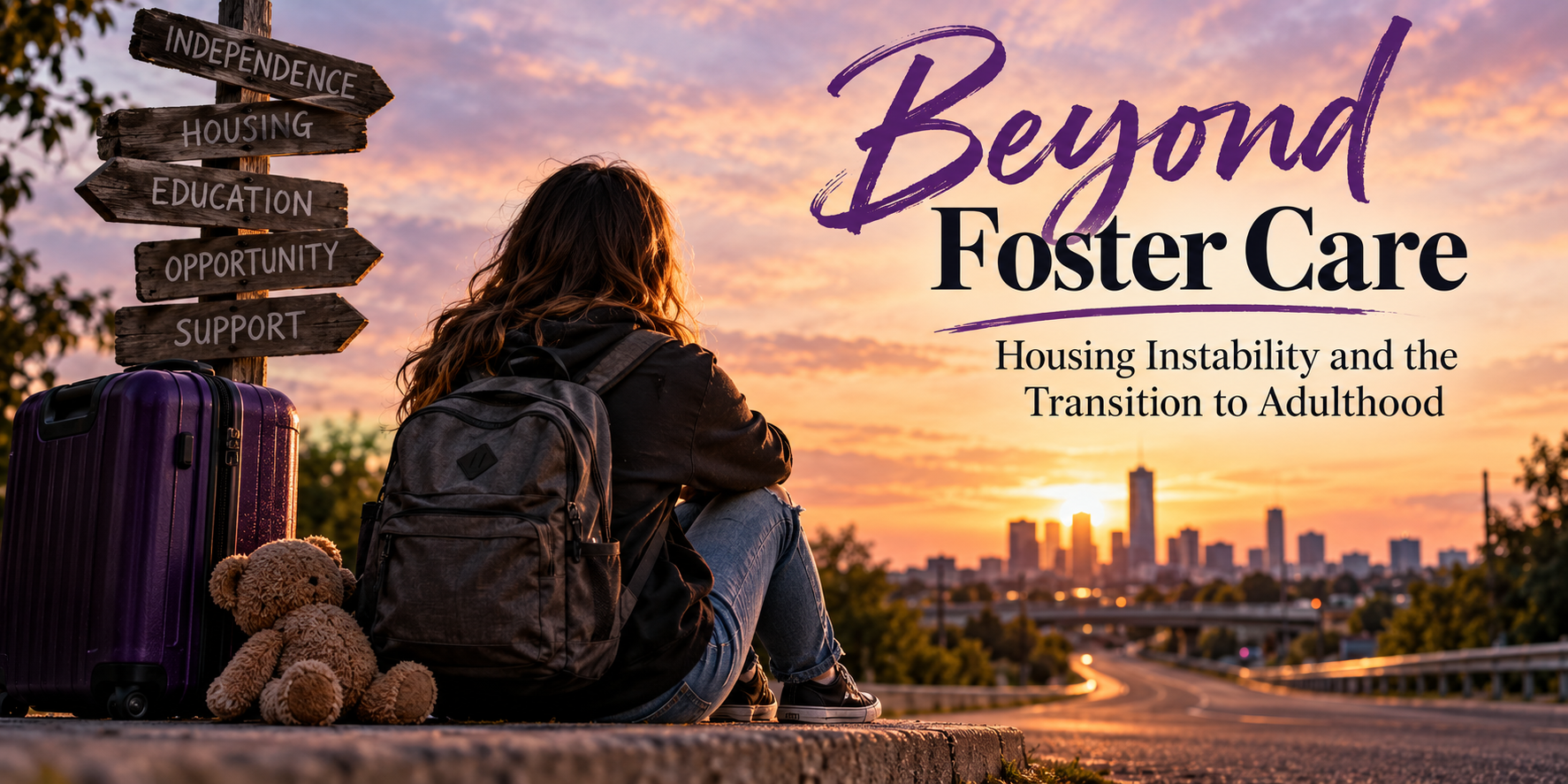
Beyond Foster Care: Housing Instability and the Transition to Adulthood
The Question
What happens to young people who leave foster care without achieving permanency?
How frequently do they experience homelessness, what circumstances contribute to housing instability, and what support is available during their transition to adulthood?
Why This Matters
For most young adults, independence develops gradually. Families and other support networks may continue providing housing, financial assistance and guidance well beyond someone's eighteenth birthday.
Young people leaving foster care may face a very different transition.
Some have established relationships with relatives, former caregivers or other supportive adults. Others leave care without reliable housing or an enduring support network.
Understanding their experiences requires examining more than whether they have somewhere to sleep immediately after leaving care.
Housing stability also involves affordability, safety, continuity and access to support.
What the Evidence Establishes
1. What Does Aging Out Mean?
Aging out generally describes leaving foster care after reaching the applicable age limit without achieving permanency through reunification, adoption, guardianship or another permanent arrangement.
However, the circumstances of young people leaving foster care differ substantially.
Some states provide extended foster care beyond age eighteen, subject to eligibility requirements.
Others offer transitional services, financial assistance or programs designed to support independent living.
Consequently, studies must identify whether their participants left care at eighteen, remained in extended care or exited under different circumstances.
These distinctions matter when interpreting outcomes.
2. What Does Research Establish About Homelessness?
One influential investigation is the Midwest Evaluation of the Adult Functioning of Former Foster Youth.
Researchers followed young people from Illinois, Iowa and Wisconsin as they transitioned from foster care into adulthood.
A subsequent analysis estimated that between 31% and 46% of study participants had experienced homelessness at least once by age twenty-six.
Among participants whose outcomes researchers observed, the figure was approximately 36%.
The broader range accounts for uncertainty surrounding participants whose outcomes were unavailable.
These findings demonstrate substantial housing instability among the population studied.
However, they should not be presented as the current national homelessness rate among all former foster youth.
The study involved particular states, eligibility requirements and historical circumstances.
3. What Contributes to Housing Instability?
The Midwest research identified several factors associated with an increased risk of homelessness.
These included greater placement instability, a history of running away while in foster care and certain adverse experiences.
Such associations do not establish that any individual characteristic inevitably causes homelessness.
Housing outcomes can also be influenced by employment opportunities, access to affordable housing, relationships with supportive adults and the availability of transitional services.
Importantly, young people leaving foster care are not a uniform population.
Individual circumstances and available support vary considerably.
4. Does Extended Foster Care Prevent Homelessness?
Research examining extended foster care in Illinois suggests that remaining in care until age twenty-one can delay the onset of homelessness.
However, researchers also found that extending care did not eliminate subsequent housing instability.
This distinction is important.
Providing additional time in care may help young people prepare for independence, but housing stability can remain challenging after those services end.
Researchers and policymakers therefore need to examine both immediate outcomes and longer-term experiences.
5. What Housing Assistance Is Available?
The federal Foster Youth to Independence initiative provides housing assistance through partnerships between public housing agencies and public child welfare agencies.
Eligible young adults may receive up to thirty-six months of rental assistance.
Certain participants may qualify for an additional twenty-four months under the Fostering Stable Housing Opportunities provisions.
The program also requires participating child welfare agencies to provide or arrange supportive services.
However, eligibility does not automatically guarantee immediate access to housing.
Program participation depends on factors including local administration, available assistance and successful coordination between agencies.
6. Do We Know Whether These Programs Work?
The existence of a housing assistance program is not the same as evidence demonstrating its effectiveness.
In March 2023, the Department of Housing and Urban Development's Office of Inspector General published an audit examining the Foster Youth to Independence initiative.
The audit identified weaknesses involving voucher utilization, oversight, supportive services and performance measurement.
These findings demonstrate the importance of evaluating implementation rather than relying exclusively on program descriptions or funding announcements.
Subsequent administrative changes may address some of these issues, but their long-term effects require outcome data.
Important Context and Limitations
Three distinctions are essential.
First: Young people who have ever experienced foster care are not necessarily representative of those who age out without achieving permanency.
Second: Experiencing homelessness at any point before age twenty-six is not equivalent to becoming homeless immediately upon leaving care.
Third: Historical research findings cannot automatically be treated as current national estimates.
Studies also differ in how they define homelessness, housing instability and the populations they examine.
Comparisons should account for those differences.
Examine the Evidence
1. Homelessness During the Transition From Foster Care to Adulthood
Peer-reviewed research analyzing the Midwest Study and estimating the cumulative incidence of homelessness through age twenty-six. This is our primary source for the historical homelessness estimate.
2. Midwest Evaluation of the Adult Functioning of Former Foster Youth
Chapin Hall at the University of Chicago, 2011.
The original longitudinal research project documenting the experiences of young people transitioning from foster care in three Midwestern states.
3. Extended Foster Care Delays but Does Not Prevent Homelessness
Amy Dworsky and Mark Courtney, Chapin Hall, 2010.
An examination of extended foster care and its relationship to subsequent homelessness.
4. HUD: Foster Youth to Independence Program
U.S. Department of Housing and Urban Development.
Official program information covering eligibility, housing vouchers, supportive services and potential extensions of assistance.
March 29, 2023.
A federal audit identifying weaknesses in program implementation and performance measurement.
What Remains Unanswered?
What proportion of young people aging out of foster care currently experience homelessness nationwide?
How do outcomes differ between states with different extended-care policies?
Which housing assistance programs demonstrate sustained improvements after financial support ends?
How do permanent relationships with supportive adults affect housing stability?
And how effectively are young people with lived experience involved in designing the services intended to support them?
Conclusion
Leaving foster care is not a single event. It is a transition that can extend across several years.
Historical research documents substantial housing instability among young people who have aged out of care.
Extended foster care and targeted housing assistance provide potential avenues of support, but their existence alone does not establish long-term effectiveness.
Understanding these outcomes requires reliable data, careful comparisons and attention to the experiences of the young people directly affected.
Research status: Documented historical findings; current national outcomes require additional verification
Last reviewed: September 26, 2026
Corrections or updates: None at this time.