The Economics of Adoption: Following the Money

What adoption costs, who receives the payments, and what financial records reveal about the American adoption system.
The Question
How much money changes hands during adoption in the United States?
Who receives that money, what services does it purchase, and how much financial information is available to the public?
Perhaps most importantly, what can financial records actually tell us about the incentives operating within the adoption system?
Why This Matters
Discussions about adoption frequently include claims that the industry generates billions of dollars annually.
But what constitutes the adoption industry?
Does that figure include private domestic adoption, international adoption, foster-care adoption, government child welfare expenditures, adoption assistance payments or services provided after an adoption is finalized?
These activities involve different organizations, funding sources and financial arrangements.
Combining their expenditures without establishing clear definitions can produce misleading conclusions.
Understanding adoption's economics requires distinguishing legitimate expenses, organizational revenue, government funding and actual profit.
What the Evidence Establishes
1. What Are Prospective Adoptive Parents Paying For?
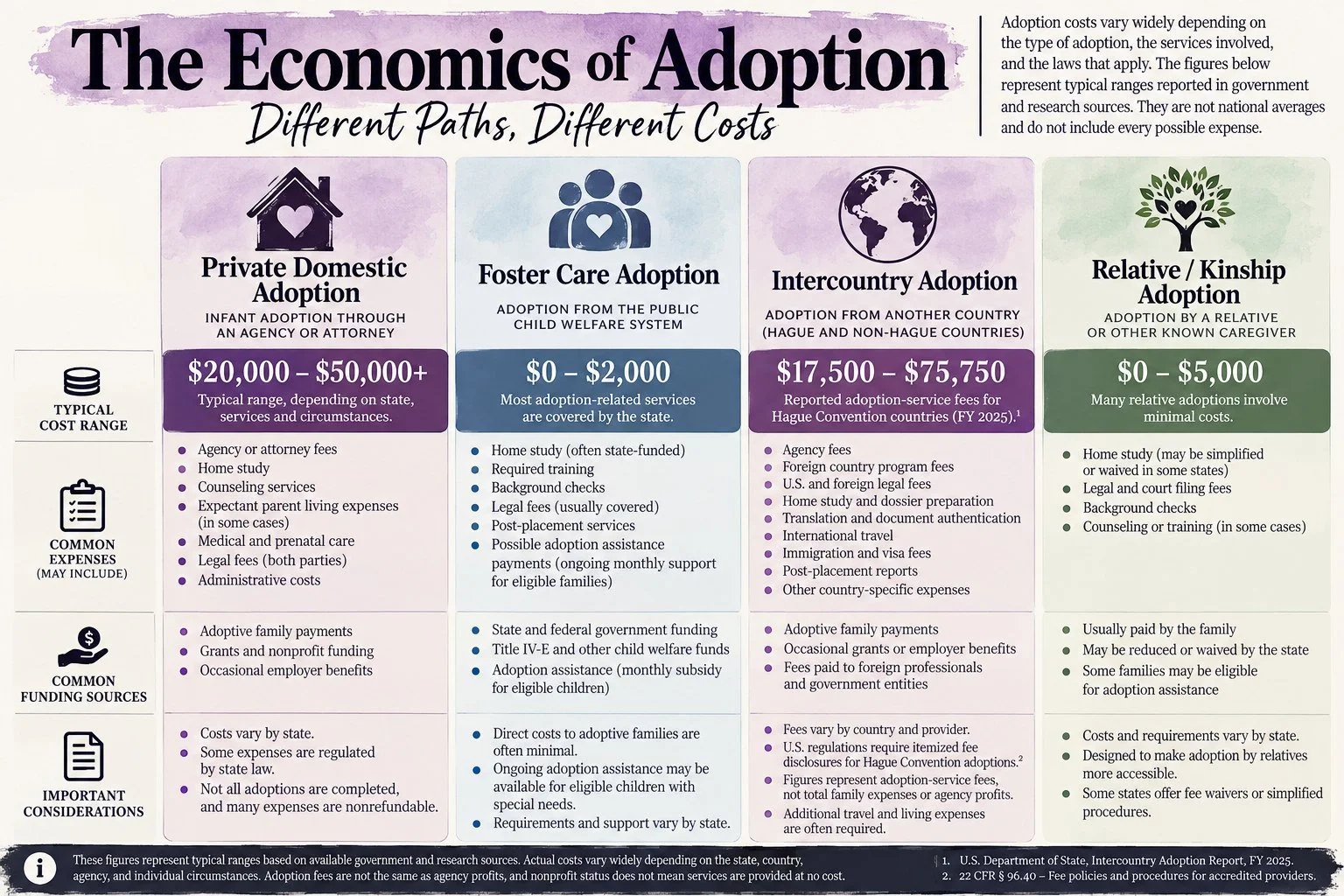
Adoption-related expenses vary substantially depending on the type of adoption and the circumstances of an individual placement.
Private domestic adoption expenses may include agency services, home studies, legal representation, counseling, medical expenses, administrative costs and certain expenses associated with an expectant parent's pregnancy.
Intercountry adoption can involve additional expenses, including international travel, immigration processing, foreign legal proceedings and services provided by organizations operating in the child's country of origin.
Adoption from foster care generally involves a different financial structure. Public agencies frequently subsidize adoption-related services, reducing the direct expenses incurred by adoptive families.
Consequently, the amount an adoptive family pays cannot be treated as the amount an agency earns or retains.
Payments may be distributed among numerous independent service providers.
2. How Much Does Adoption Cost?
There is no single national price for adoption.
The U.S. Department of State collects fee information from adoption service providers involved in intercountry adoption.
Its fiscal year 2025 reporting provides information about adoption-service fees charged by participating providers.
However, those figures do not represent every expense incurred by adoptive families. Nor do they represent the cost of domestic adoption.
Similarly, published estimates of private domestic adoption costs vary according to the services included, geographic location and whether a placement is completed.
A meaningful financial comparison must therefore identify the type of adoption, the reporting year, the population studied and the expenses included.
3. How Do Nonprofit Adoption Agencies Generate Revenue?
A nonprofit organization can collect adoption fees, receive donations, employ paid staff, own property and accumulate financial reserves.
Nonprofit status does not mean that an organization operates without revenue or that every service is provided at cost.
Instead, nonprofit organizations operate under legal restrictions concerning how organizational earnings may be distributed and used.
Adoption agencies may receive income from adoption-related services, charitable contributions, grants and other permitted activities.
Their expenses may include employee compensation, facilities, counseling, administrative operations, professional services and programs unrelated to adoption placement.
These financial arrangements can be examined through publicly available records.
Most tax-exempt organizations meeting applicable filing requirements submit annual information returns to the Internal Revenue Service.
IRS Form 990 can reveal organizational revenue, expenditures, executive compensation and other financial information.
However, these records have limitations.
An agency offering several different services may report combined organizational revenue without identifying how much income originated from individual adoption placements.
Additionally, organizational revenue is not equivalent to profit.
4. What Financial Incentives Exist?
When an organization receives revenue from providing a service, financial incentives may influence its operations.
That observation applies to many industries and nonprofit services. It does not independently establish misconduct.
In adoption, the relevant questions concern how organizations structure their fees, whether employees are rewarded for particular outcomes, how counseling services are funded and whether financial arrangements create conflicts of interest.
For example, a prospective adoptive family's payment may cover legitimate professional services even when an adoption does not proceed.
However, fee structures that create financial pressure to complete placements deserve examination.
A meaningful investigation should consider whether expectant parents receive independent counseling, whether they understand their available options and whether the financial interests of professionals could conflict with those of the families receiving their services.
Financial records alone cannot establish that coercion occurred.
They can, however, identify arrangements that warrant further investigation.
5. What Laws Regulate Adoption-Related Payments?
Adoption-related financial regulations differ according to the type of adoption and the jurisdictions involved.
In private domestic adoption, states establish rules concerning permissible expenses, disclosure requirements and prohibited payments.
These rules commonly address agency fees, legal expenses, medical costs and certain pregnancy-related expenditures.
Oklahoma, for example, requires written disclosure of adoption-related costs and expenditures in direct-placement adoptions.
Intercountry adoption is subject to additional federal requirements.
The Hague Adoption Convention prohibits improper financial gain and permits reasonable costs and professional fees.
U.S. regulations require covered adoption service providers to disclose itemized fees and estimated expenses.
They also prohibit payments intended to induce parents to relinquish their children.
These safeguards establish legal requirements. Their existence alone does not demonstrate that every organization complies with them.
6. What Does Government Funding Tell Us?
Government expenditures introduce another important distinction.
Federal and state governments fund child welfare services, including foster care, adoption assistance, administrative operations and certain services intended to prevent children from entering foster care.
These expenditures do not represent a single pool of money paid to adoption agencies.
Adoption assistance payments, for example, may provide ongoing support to eligible adoptive families.
Prevention funding may support services intended to help children remain safely with their families.
A comprehensive examination of public spending must distinguish these different programs rather than classify all child welfare expenditures as adoption-industry revenue.
7. Can We Calculate the Total Size of the American Adoption Industry?
Not reliably without first defining what should be included.
An industry-wide estimate would require consistent financial information from private agencies, independent professionals, public child welfare agencies, intercountry adoption providers and potentially numerous related service organizations.
Available reporting systems were not designed to produce one comprehensive financial statement for all these activities.
Some organizations also provide multiple services, creating a risk of counting the same financial activity more than once.
For example, an agency may pay an independent professional using revenue collected from adoptive families.
Adding the agency's entire revenue to the professional's revenue without accounting for that transaction would inflate the resulting estimate.
A credible calculation would need to identify its population, reporting period, included services and method for preventing double counting.
Without those elements, claims about the industry's total financial value should be treated cautiously.
Important Context and Limitations
Three distinctions are particularly important.
First: Adoption fees are not equivalent to agency profits. Payments may cover multiple services provided by independent professionals.
Second: Nonprofit status does not establish ethical conduct, but collecting substantial revenue does not independently establish misconduct either.
Third: Government child welfare spending cannot automatically be classified as adoption-industry revenue.
Financial transparency allows researchers to examine organizational practices. However, financial records should be considered alongside licensing records, regulatory findings, institutional policies and the experiences of people directly affected by adoption.
Examine the Evidence
Primary government sources
1. U.S. Department of State: Annual Reports on Intercountry Adoption
U.S. Department of State, fiscal years 2008–2025.
The department publishes annual reports documenting intercountry adoption activity, adoption-service fees and regulatory information. These reports allow researchers to compare financial disclosures across reporting years.
2. IRS: Public Disclosure Datasets and Downloads
Internal Revenue Service.
This resource provides access to tax-exempt organizations' financial filings, including Form 990. Researchers can use these documents to examine individual adoption agencies' reported revenue, expenses and compensation.
3. Regulation of Private Domestic Adoption Expenses
Child Welfare Information Gateway, U.S. Department of Health and Human Services
A state-by-state examination of laws governing permissible adoption expenses, payment restrictions and financial disclosures.
4. Hague Convention on Protection of Children and Co-operation in Respect of Intercountry Adoption
Hague Conference on Private International Law, 1993.
Article 32 addresses improper financial gain, reasonable professional fees and compensation associated with intercountry adoption.
5. 22 CFR § 96.40: Fee Policies and Procedures
U.S. federal regulations.
Establishes financial disclosure requirements for covered intercountry adoption service providers, including written schedules of fees and estimated expenses.
6. Oklahoma Statutes, Title 10, § 7505-3.2
State of Oklahoma, 2025 statutory compilation.
Addresses disclosure and judicial review of adoption-related expenditures, including payments associated with direct-placement adoptions.
Additional research resources
Planning for a Home Study, Child Welfare Information Gateway. Explains how home-study expenses differ between private adoption and foster-care adoption.
Title IV-E Prevention Services Clearinghouse, U.S. Department of Health and Human Services. Provides information about federally supported programs intended to prevent foster-care placements.
Adoption and Foster Care Analysis and Reporting System (AFCARS), Children's Bureau. Provides government data for studying public foster care and adoption, although it is not a comprehensive accounting of adoption-related finances.
A chart worth including
What Remains Unanswered?
How much revenue do private domestic adoption placements generate nationally?
What proportion of adoption-agency expenditures directly supports expectant parents and children?
How frequently do agencies provide independent counseling, and how are those services funded?
How do different fee structures affect organizational decision-making?
And what additional reporting requirements would make the financial relationships within adoption easier for the public to understand?
These questions provide opportunities for further research.
Conclusion
The economics of adoption cannot be reduced to a single dollar figure.
Private domestic adoption, intercountry adoption and foster-care adoption involve different financial structures, regulatory requirements and sources of funding.
Existing government reports, tax filings and statutory requirements provide important information, but they do not collectively establish a definitive national total for adoption-related revenue or profit.
Understanding the financial system requires following individual transactions, examining organizational records and distinguishing documented findings from assumptions.
The central question is not simply how much money changes hands.
It is whether the available evidence allows us to understand where that money goes, how financial arrangements influence institutional decisions and whether appropriate safeguards protect the people involved.
Research status: Documented financial structures; incomplete industry-wide financial data
Last reviewed: September 26, 2026
Corrections or updates: None at this time.